

Wilson Blade V10 2026 Review – The Wilson Blade has long been synonymous with control, precision, and uncompromising feel. Walk into any competitive club and you’ll spot it in the hands of serious players—and increasingly, on the professional tour. After nearly two years on the market with the v9 (launched February 2024), Wilson’s next evolution is finally arriving: the Blade V10, expected to hit shelves in mid-April 2026. Here’s everything we currently know about the most anticipated control racquet of the year.
Expected Release Date & Timeline
Wilson Blade V10 2026 Review – Based on information available so far, Wilson dealer discussions, and sightings of pro stock frames, the Wilson Blade V10 is confirmed for an April 2026 release. This follows Wilson’s typical update cycle of every two to three years, with the v9 having arrived in early 2024.
Notably, pro stock versions of the V10 have already been spotted in the wild, particularly in the hands of Stefanos Tsitsipas, who has been extensively testing the new mold under a designation called “Blade V10 Taper”. These test frames have appeared with Tsitsipas’s personal specifications and in his preferred 18×19 string pattern, suggesting he’s conducting serious on-court evaluation ahead of the public launch.
Multiple TennisWarehouse forum users and gear enthusiasts have confirmed sightings of blackout V10 frames and retail packaging, indicating the racquet is in final production stages. The timing suggests retail availability will follow closely behind the April launch window.
The Blade V9 Context: What Came Before
Wilson Blade V10 2026 Review – To understand what’s changing with the V10, it’s important to recognize what made the V9 so successful. Launched in February 2024, the V9 introduced StableFeel technology—a refined carbon fiber layering system that increased frame stability by 10% compared to the v8. This improvement addressed the core Blade philosophy: delivering consistent feedback and control even on off-center strikes.
The v9 also introduced the Clip & Go grommet system for easier string maintenance, while retaining the signature 16×19 and 18×20 string patterns that define the Blade’s spin-friendly, precision-focused approach. The frame remained a 62 RA stiffness, positioning it as an advanced player’s racquet requiring clean fundamentals and elite-level technique.
Current V9 specifications (for reference):
• Head Size: 98 sq.in. / 100 sq.in. (two primary models)
• Beam Width: 21mm (consistent throughout)
• String Pattern: 16×19 and 18×20 (spin-focused)
• Stiffness: 62 RA
• Technology: StableFeel (10% stability increase)
What’s Rumoured / Emerging From Early Playtests
Wilson Blade V10 2026 Review – Wilson hasn’t officially announced comprehensive V10 specs, so much of this is based on dealer intel, pro stock analysis, and informed industry speculation. However, several concrete changes have been confirmed:
This is not an official spec sheet. The insights below are compiled from pro stock sightings, dealer intelligence, forum reports, and early tester feedback — useful indicators, not final confirmation.
Frame Design & Geometry Changes Specs
- Revised throat/taper geometry spotted on pro stock frames — optimized for stability without sacrificing feel.
- Beam width increase from 21mm to 21.5mm–22mm on 98-inch models for improved off-center performance.
- Maintained 62 RA stiffness — consistency with V9 platform.
- StableFeel 2.0 technology (evolved carbon fiber layering) for enhanced frame rigidity.
Power, Control & Feel Profile Performance
- “Amplified Aggression” codename suggests added power generation without compromising precision.
- Larger effective sweet spot — off-center hits more forgiving than V9.
- Maintained control DNA — early testers report similar feedback and feel to V9.
- Improved stability on topspin-heavy strokes without sacrificing directional control.
Models & String Patterns Lineup
- Blade 98 & Blade 100 expected as primary models.
- 98-inch (18×19) aimed at precision-first, spin-oriented hitters.
- 100-inch (16×19) focused on depth, forgiveness, and accessibility.
- Possible 16×20 variant (unconfirmed) for maximum spin enthusiasts.
- 18×20 pattern likely retained for hardcore control players.
Cosmetics & Design Aesthetics
- “Championship Green” colorway — vivid emerald finish, Wimbledon-inspired aesthetic.
- Glossy coating for premium look and feel.
- Professional, refined visual identity — less aggressive than recent Blade designs.
- Distinctive from V9 — new design language signals generational shift.
Pro Players Testing & Adoption Tour
- Stefanos Tsitsipas — primary test pilot with confirmed pro stock 18×19 frames (Blade V10 Taper).
- Aryna Sabalenka & Madison Keys — likely early adopters (existing Blade loyalists).
- Early feedback positive — testers report improved power delivery while maintaining V9-like feel.
- Expected tour adoption by mid-2026 as players transition from V9.
What Hasn’t Changed DNA
- Control-first philosophy remains — V10 is evolution, not reinvention.
- Built for advanced players with clean fundamentals and elite-level technique.
- Blade identity preserved — this is not a power racquet, despite improvements.
- Precision positioning — still aimed at serious competitors, not casual players.
Release Timeline & Availability Release
- Expected release: Mid-April 2026 — confirmed via dealer partnerships and retail preparation.
- Pro stock frames already in testing with elite players.
- Retail packaging sighted in final production stages.
- V9 likely to discount post-launch — good opportunity for budget-conscious buyers.
Final retail specs and cosmetics may differ from current information. This section reflects early intelligence from pro stock sightings, dealer reports, and forum discussions — not official Wilson confirmation.
Cosmetics: “Championship Green” Design
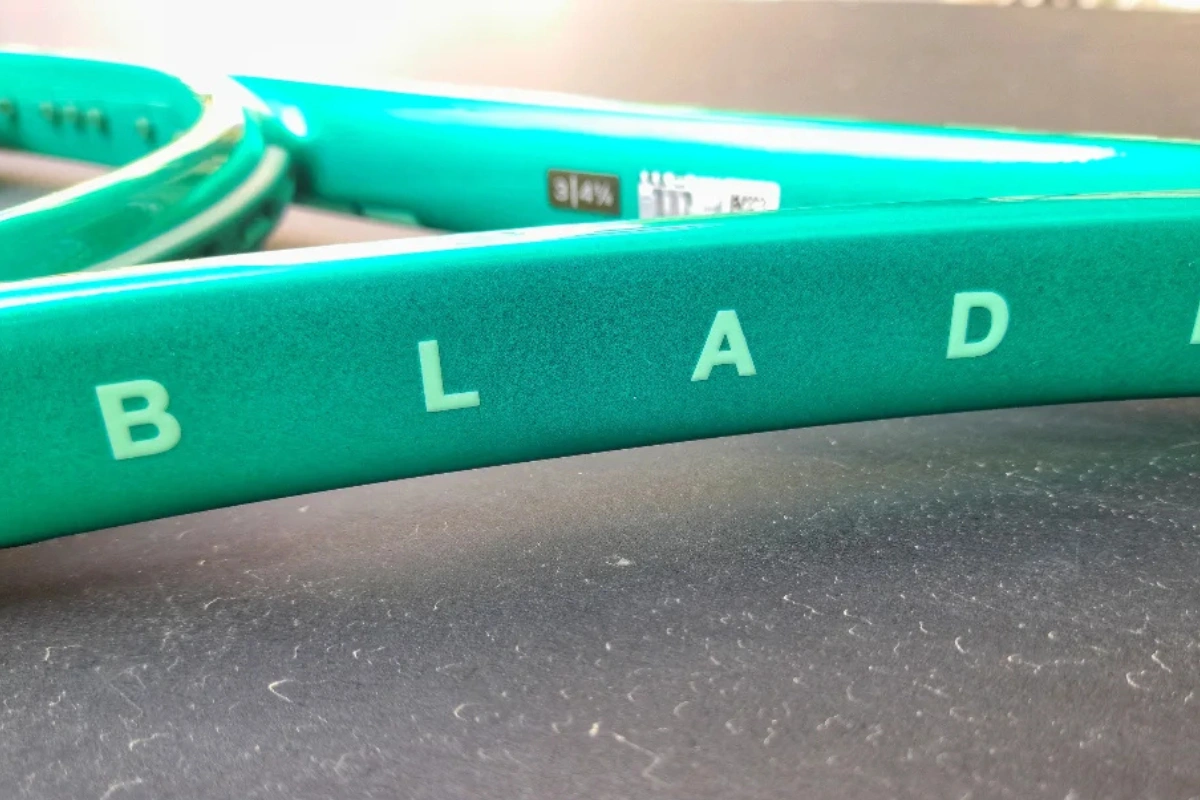
Wilson Blade V10 2026 Review – The V10’s visual identity represents a dramatic departure from recent Blade aesthetics. The new color scheme is called “Championship Green” – a vivid, emerald-inspired shade reminiscent of the Wimbledon logo.
Key cosmetic details:
• Primary Color: Championship Green (metallic/glossy finish)
• Finish: Glossy coating (per multiple confirmations)
• Aesthetic: Professional, elegant, less aggressive than recent Wilson designs
• Design Language: Refined and premium, appealing to serious players
Multiple reports describe the color as “vibrant and lively, resembling an emerald green or jungle-inspired tone”. In glossy finish, early samples appear striking without being gaudy—maintaining the Blade’s professional positioning.
Interestingly, pro stock frames (particularly Tsitsipas’s test models) retain the V9’s glossy paintjob during testing, suggesting Wilson’s graphics team is still finalizing retail colorway designs.
Pro Players Testing the V10
Stefanos Tsitsipas – Primary Test Pilot
Stefanos Tsitsipas has emerged as the primary pro testing the V10, with confirmed sightings of personal pro stock frames in the 18×19 string pattern. This is particularly significant because:
1. Tsitsipas is one of the tour’s most racquet-conscious players, constantly experimenting with equipment
2. He previously played a Pure Aero 98 Blackout, indicating willingness to test non-Blade options
3. His V10 test frames are genuine pro stock equipment made specifically for his specifications
4. He’s reportedly exploring the V10 as a primary option, suggesting Wilson believes the frame will be competitive at the absolute elite level.
Multiple sources confirm Tsitsipas has been testing the V10 alongside other Wilson prototypes, evaluating whether it offers the power and spin he seeks without compromising the control foundation.
Aryna Sabalenka & Madison Keys – Existing Blade Loyalists
Both Aryna Sabalenka and Madison Keys are long-standing Blade users, though recent events suggest Sabalenka may be testing new equipment. After losing the 2025 Australian Open final to Keys, Sabalenka expressed frustration—but also interest in exploring new frame options to add power to her game.
Madison Keys, who won the 2025 Australian Open (her first Grand Slam), has been a consistent Blade user and is likely to migrate to the V10 upon release. While neither player has been explicitly confirmed testing V10, their loyalty to the Blade line and Wilson partnership makes them probable early adopters upon release.
Other Blade Professionals
Additional confirmed or probable Blade V10 testers include:
• Alex de Minaur (consistent Blade user)
• David Goffin (long-time Blade advocate)
Control & Precision Core identity
The Blade v10 remains the ultimate control racquet for precision-focused players. Expect unmatched feedback and feel at contact, refined further through the new throat geometry and StableFeel enhancements — creating a direct connection between stroke intention and ball response.
Stability & Torsion Resistance Key upgrade
The refined throat geometry (wider taper mold) and enhanced StableFeel technology deliver improved off-center stability without sacrificing the legendary feel. The v10 should resist twisting on mishits more effectively while maintaining the flexible responsiveness that defines the Blade.
Wider throat resists frame rotation on off-center balls without harsh impact feel.
Refined geometry maintains precise stringbed plane for consistent contact patterns.
Power & Aggression New direction
Wilson explicitly promises “amplified aggression” and “more power” while maintaining control. Expect the v10 to generate slightly increased pace through improved stability (freeing the stringbed) and potential refinements to the beam profile — a rare shift for the control-first Blade philosophy.
Feel & Responsiveness Sacred trait
The Blade’s legendary responsiveness and feedback at contact must remain central to the v10 identity. Any refinements to geometry or stiffness should preserve — or enhance — this direct connection between player intention and ball response, rewarding clean technique and punishing sloppy mechanics.
Clean strikes still provide that signature responsive, connected sensation Blade players crave.
Off-center and mistimed contact remain clearly audible and tactile — demanding clean technique.
Spin Potential & Versatility String pattern driven
Spin production on the Blade depends entirely on string pattern choice: the 16×19 delivers higher RPM through open string spacing and snap-back potential, while the 18×20 prioritizes control with tighter stringbed consistency. Both patterns will continue in the v10, maintaining this critical player choice.
Frame Build & Geometry Expected specs
The v10 will likely maintain the Blade 98’s core specifications — 98 sq in head, 305g unstrung, 21mm beam, 32cm balance — with refinements to the throat taper geometry. Pro stock frames show a visibly wider throat mold, suggesting improved stability geometry without major mass redistribution.
Competitive, demanding sizing. Rewards precision, not forgiveness. Unchanged from v9.
Wider taper mold visible on pro stock frames — enhanced stability without sacrificing feel.
Strings That Elevate the Blade V10 2026
Wilson Blade V10 2026 Review – Wilson Blade v10 Review — One of the best ways to unlock the full potential of the Blade v10 is to match your string choice to your playing style and court position — because the Blade is fundamentally a precision-first control racquet that rewards feel and technique above all else. The right setup enhances that legendary feedback, sharpens directional control, maintains consistency under pace, and preserves the frame’s responsiveness, while the wrong one can make a Blade feel muted, harsh, or disconnected from the stringbed.
The Blade v10 is built for precision, feel, and consistency — not spin chasing or power hunting. String choice on the Blade matters more than most frames because every choice either enhances or dilutes that legendary feedback and control identity. Below are clean starting-point string picks by playing style, plus why they fit the v10’s DNA.
| Playing Style | Focus | Suggested Strings | Why It Works | Tension* |
|---|---|---|---|---|
| Pure Control Player | Directional Precision |
Luxilon ALU Power Rough Yonex Poly Tour Rev Solinco Tour Bite |
Blade’s tightest stringbed (18×20) + structured polys = razor-sharp directional control with zero mushiness. Precision baseline exchanges. | 24–26 kg |
| Balanced Technician | Feel + Spin Balance |
Grapplesnake Tour M8 (hybrid) Head Lynx Tour (thin gauge) Tecnifibre Triax (hybrid) |
Hybrids give the Blade a softer, more connected feel while maintaining control. Tour M8 specifically preserves that legendary Blade responsiveness without harshness. | 22.5–24.5 kg |
| Spin-Oriented (16×19) | RPMs + Control Mix |
Babolat RPM Blast (thin gauge) Yonex Poly Tour Pro Solinco Hyper-G |
Open 16×19 pattern loves rough polys for snap and bite. These grab the ball without compromising the Blade’s inherent precision and feel. | 22–24 kg |
| Comfort-Focused | Arm-Friendly Feel |
Tecnifibre Multifeel Head Velocity MLT Babolat Xplore |
Softer, more elastic strings reduce impact shock while maintaining the Blade’s signature feedback. Great for players hitting frequently or managing arm sensitivity. | 21.5–23.5 kg |
| Aggressive Baseline (18×20) | Stable Power |
Luxilon 4G (tension hold) Solinco Confidential Babolat RPM Blast Rough |
Blade’s control DNA + tight 18×20 + durable poly = you can swing full pace and the stringbed stays locked in. No feedback loss at impact. | 24–26 kg |
| Touch + Volleys | Feel Maximization |
Grapplesnake Tour M8 (main/cross) Head Lynx Tour (thin gauge) Tecnifibre Multifeel |
The Blade already rewards technique—softer, more responsive strings amplify that. Volleys and drop shots feel crisp, not dead. | 22–24 kg |
| Pro Stock Mentality | Match Stability |
Luxilon 4G (thicker gauge) Yonex Poly Tour Rev (Pro spec) Babolat RPM Blast Rough |
High tension + durable polys = stringbed stays true for 5–6 sets. Blade players value consistency—these maintain playability through long matches. | 25–26 kg |
*Tension ranges are starting points. Adjust ±1–2 kg for swing speed, arm comfort, and feel preference. The Blade rewards precision—even small tension changes noticeably affect control.
Final Take: Should You Wait for the 2026 Blade?
Wilson Blade V10 2026 Review – If you’re considering a racquet that maximizes control with uncompromising precision and elite feel, the Wilson Blade v10 appears poised to be a meaningful refinement. Early reports from pro stock testing point to improved stability through refined throat geometry, enhanced StableFeel technology, and amplified aggression while preserving the control-first identity that has made the Blade the choice of precision-obsessed players worldwide.
That said, nothing replaces official specs and press releases from Wilson — as of early 2026, the Blade v10 launch is imminent (April 2026), with pro stock testing and community feedback shaping expectations around the new taper mold geometry and refined StableFeel implementation.
If you enjoyed this breakdown, you might also like my article on Wilson Python 2026 Rumours.

2 thoughts on “Wilson Blade V10 2026 Review — What We Know So Far from Testing”