

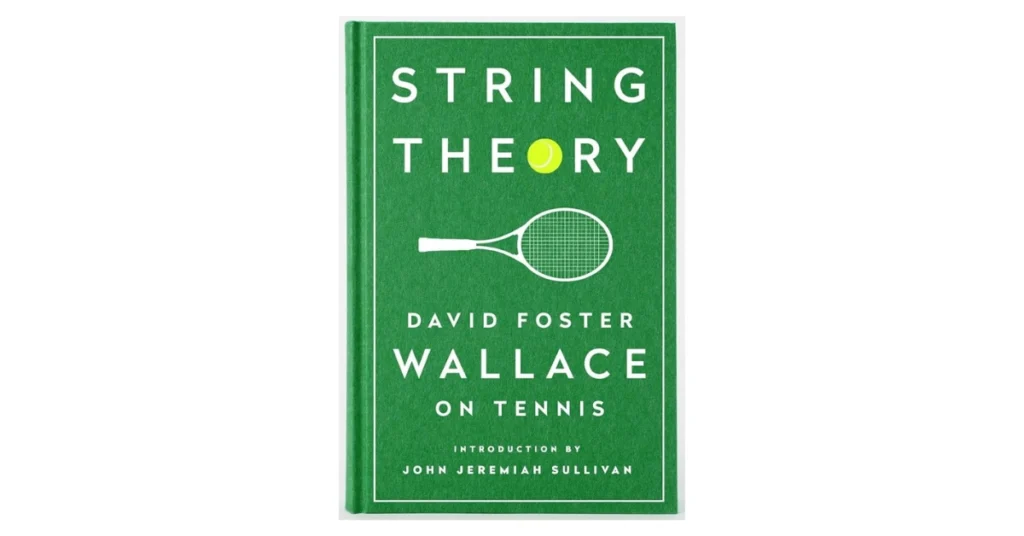
String Theory David Foster Wallace on Tennis – There are books about tennis that talk about how to hit the ball… Then there’s String Theory. David Foster Wallace doesn’t just write about tennis; he breaks it down, loves it, and makes art out of it.
Originally published in magazines like Esquire and The New York Times, this small book of essays is not a manual or a memoir. It’s a love letter to the sport from someone who played, struggled, and obsessed over every angle, spin, and sound that happens between the baselines.
Wallace somehow finds the right words for that one-in-a-thousand ball that makes time stop when you stand on a court and feel that perfect clean connection off the strings.
The essence of the book
String Theory David Wallace on Tennis gathers five essays that span Wallace’s writing career, exploring tennis from multiple angles: the lonely grind of lower-ranked pros, the quiet rituals of mid-tier tournaments, and the transcendent genius of players like Roger Federer.
He’s not an outsider looking in. Wallace was a competitive junior player growing up in Illinois, and you can feel that insider’s perspective in every paragraph. He knows the smell of hard courts baking in the sun. He knows what it feels like to mishit a second serve at 5–6 in a tiebreak.
This isn’t just journalism — it’s writing from someone who understands that tennis, at its core, is both brutal and beautiful.
Federer and the “Religious Experience”

The standout piece — and maybe one of the greatest sports essays ever written — is Federer Both Flesh and Not. Wallace describes Federer not just as an athlete, but as something close to a miracle.
He coins the phrase “Federer moments” — those rare flashes when Federer does something so fluid and perfect that it feels transcendent. It’s writing that reminds you why sport can be art.
Wallace’s prose is packed with awe, but never naïve. He knows exactly how much pain and discipline sits underneath Federer’s elegance. He connects the grind of competition to something larger — what it means to witness human excellence up close, and how fleeting those moments are.
Reading that essay, you can almost hear the sound of the ball striking the strings. It’s as if you’re sitting courtside, holding your breath.
Beyond Federer: The Life Beneath the Tour
Not every story in String Theory is about greatness. Wallace spends as much time with players just outside the spotlight — like Michael Joyce, then a talented journeyman grinding it out in Challenger events.
In that essay, Wallace turns a second-tier tournament into something Shakespearean. He finds beauty and tragedy in the effort itself — the endless flights, the bad hotels, the constant reminder that even at the edge of the elite, success is fragile.
You realize that for every Federer, there are hundreds of players like Joyce — equally dedicated, just less blessed by timing or talent. Wallace gives them dignity, attention, and empathy.
Why It’s Special
There’s something almost spiritual about the way Wallace approaches tennis. He blends the precision of an analyst with the heart of a fan.
He writes about string tension, biomechanics, and shot trajectory, but also about loneliness, identity, and the psychology of performance. It’s not just what happens on the court — it’s what it means.
He captures the weird mix of arrogance and doubt that every tennis player feels — the solitude, the obsession, and the ecstasy when everything clicks for a moment.
It’s writing for people who’ve fallen in love with the game — and maybe even been broken by it once or twice.
The Writing Itself
Wallace’s writing style is famously dense — packed with footnotes, tangents, and parentheses. But in String Theory David Wallace on Tennis, it works perfectly. The complexity mirrors tennis itself: no straight lines, no easy answers, everything in motion.
There are sentences that read like poetry — long, rhythmic, breathless descriptions that make you stop mid-page. He can describe a rally like a composer building a symphony: rising tension, brief silence, explosive release.
Why Every Tennis Player Should Read It
If you play, watch, or even think about tennis, this book gives you a whole new lens.
Wallace shows that tennis is a mirror — a way of exploring the mind, the body, and the contradictions of human effort. Whether you’re a weekend hacker or a coach, you’ll recognize yourself somewhere in his words: the nerves before a serve, the internal dialogue, the fleeting joy of a perfect shot.
It’s also a reminder that the game isn’t just physical. It’s emotional, psychological, and even philosophical. And that’s exactly what makes it worth playing.
The Takeaway
String Theory isn’t an easy read — but it’s a rewarding one. It sits somewhere between literature, philosophy, and pure tennis nerd joy.
For me, it’s one of those rare books that deepens your relationship with the game. It makes you look at tennis differently — slower, sharper, with more appreciation for the strange beauty of hitting a small yellow ball inside white lines.
If you’ve ever loved tennis — really loved it — this is a book that will speak your language.
Final verdict
⭐️⭐️⭐️⭐️⭐️ — Essential reading for tennis lovers who see the sport as more than just a game.
If you love tennis and great writing, String Theory David Wallace on Tennis is one of those rare books that makes you see the game — and maybe yourself — in a new way. It captures everything from the poetry of Federer’s movement to the raw solitude of competition.
You can find more of my tennis reviews, string tests, and gear insights over on my 👉 blog!
