
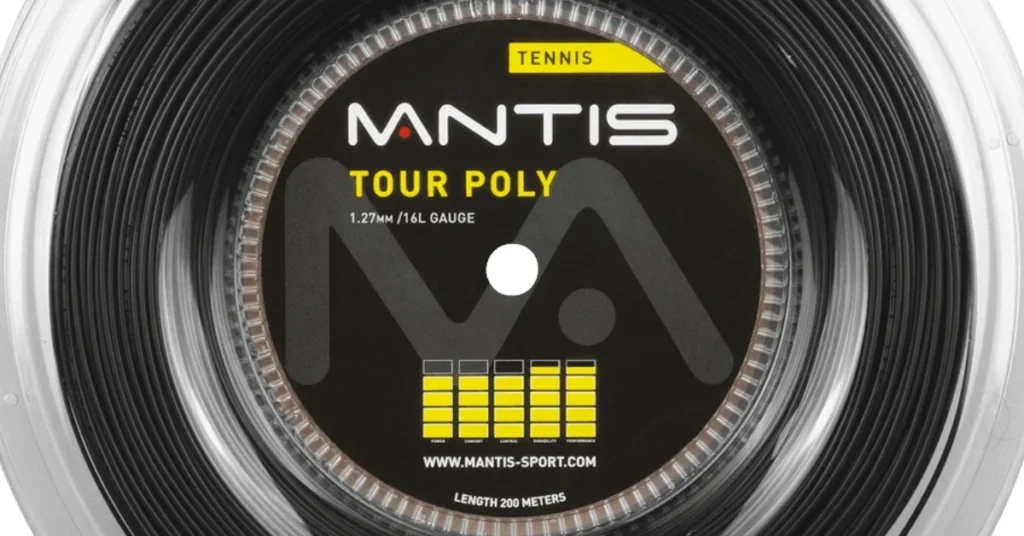
Mantis Tour Poly 1.27 is one of those understated strings that quietly delivers serious performance for its price. It’s built for players who value spin, control, and predictable response, but don’t want the stiffness or harsh feedback found in many performance polys. The result? A string that’s crisp, consistent, and surprisingly forgiving — ideal for intermediate to advanced players looking for control without sacrificing too much feel.
Quick verdict
Mantis Tour Poly offers impressive spin and control, along with a lively feel off the strings. It’s not the softest poly, but it’s more arm-friendly than most in this category. The tension holding could be better, but overall, it’s a dependable, value-packed choice for players seeking precision and spin at a reasonable price point.
What the numbers and lab tests say
Official lab testing highlights why Tour Poly remains a favourite among control-seeking players:
| Attribute | Score | What It Means |
|---|---|---|
| Spin | 95% | Excellent bite and snapback – grips the ball confidently for heavy topspin. |
| Control | 90% | Precise and predictable response – easy to direct shots with confidence. |
| Power | 90% | Offers easy depth when you commit to full swings – not a dead-feeling poly. |
| Resilience Peak | 75% | Retains good liveliness, giving a responsive feel without overhitting. |
| Comfort | 70% | Softer than most control polys – clean, slightly muted response that’s arm-friendly. |
| Elasticity | 50% | Firmer string with limited stretch – delivers a consistent, stable string bed. |
| Tension Holding | 65% | Average – performance drops gradually, so restringing regularly helps maintain feel. |
| Stability | 60% | Reasonable consistency, though not designed for long-term durability. |
👉 In short: Tour Poly is a firm, controlled co-poly that keeps you connected to your shots, without punishing your arm.
How it plays (feel, spin, power, control)
On court, Mantis Tour Poly feels clean and direct — it rewards players who take full, confident swings. Spin access is excellent thanks to the slick surface and predictable snapback, and the 1.27mm gauge offers a perfect balance of bite and stability.
Power is available when you go after it, but this is still a control-first poly — perfect for players who like to take big cuts from the baseline and trust the string to keep the ball in. The feedback is crisp but not overly stiff, making it easy to find rhythm over longer hitting sessions.
The comfort level is better than expected for a performance poly, especially when strung in mid-range tensions (22–23 kg). It offers enough give to absorb impact without feeling mushy.
Durability & tension maintenance
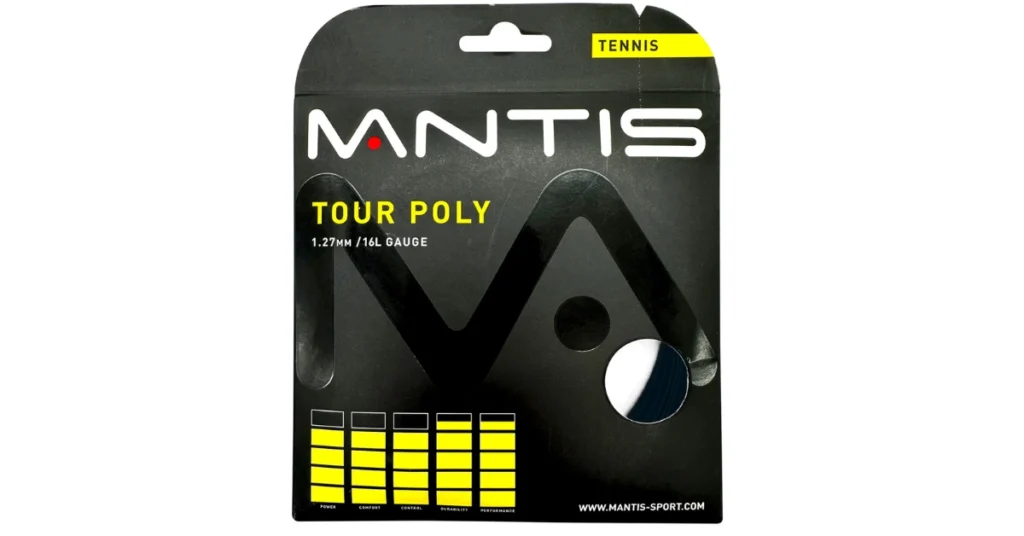
With tension holding at 65% and stability at 60%, Mantis Tour Poly performs best over the first 8–10 hours of play. After that, tension drop becomes noticeable, especially in open-pattern frames like the Pure Aero or VCORE 100.
That said, it maintains spin and directional accuracy fairly well before eventually softening. For frequent players, restringing every 10–12 hours is recommended to maintain the crisp, predictable feel. See my guide here on choosing the right tennis string tension.
Playability window: expect around 8–12 hours before noticeable drop-off.
If you want to extend its lifespan, pairing it with a firmer cross (like Restring Sync or Kirschbaum Max Power) can help stabilise performance.
Who it suits
Best For:
- Intermediate to advanced players who want spin and control with a touch of comfort
- Players who like a connected, predictable response from their string bed
- Those seeking a high-performance option at a reasonable cost
Not For:
- Beginners or touch-oriented players looking for effortless power
- Heavy hitters who need maximum tension stability
Best suited racquets
Mantis Tour Poly 1.27 pairs best with racquets that emphasise precision and spin control, making it ideal for advanced intermediates and control-focused players. Its firm, crisp feel brings stability and accuracy to frames that already offer a bit of power.
It works beautifully in modern control racquets like the Wilson Blade 98 and Yonex Percept 97, where its predictable response lets you swing freely without fear of overhitting. In spin-oriented frames such as the Babolat Pure Aero or Head Extreme MP, it enhances spin and direction while keeping the ball inside the lines.
For players using tweener racquets (like the Yonex Ezone 100 or Wilson Clash 100), Mantis Tour Poly can add extra control — though it’s worth dropping tension slightly for comfort and pocketing.
| Racquet Type / Model | Why It Works | Notes |
|---|---|---|
| Wilson Blade 98 / Yonex Percept 97 | Adds spin and crisp control while keeping feel precise and predictable. | Ideal tension: 22–23 kg for balance of comfort and accuracy. |
| Babolat Pure Aero / Head Extreme MP | Enhances topspin and control on fast swings without losing depth. | Consider slightly higher tension (23–24 kg) to tame power. |
| Yonex Ezone 100 / Wilson Clash 100 | Brings consistency and direction to more powerful frames. | Drop tension by 1–2 kg for improved comfort and feel. |
| Head Speed MP / Tecnifibre TF40 305 | Complements control-oriented frames with consistent response and clean feedback. | Best for advanced players seeking precision. |
Comparable strings
If you like the feel of Mantis Tour Poly, also consider:
- Head Lynx Tour 1.25 – firmer, more spin-oriented
- Solinco Confidential 1.25 – sharper, with more bite and tension stability
- String Project Sirius 1.25 – softer and more arm-friendly
- Kirschbaum Max Power 1.25 – a little stiffer but longer-lasting
Practible recommendations
Tension:
Start at your regular polyester reference tension (around 22–24 kg). If you want a touch more control, go higher (23–24 kg). For extra comfort and pocketing, drop the tension slightly (20–21 kg).
Gauge:
The 1.27mm gauge offers a solid blend of control and durability. Players wanting more spin and feel can drop to 1.23mm, while heavy hitters who break strings often might prefer 1.30mm for extra longevity.
Hybrid Options:
For those seeking more comfort, consider a hybrid setup — Mantis Tour Poly in the mains and a softer cross such as Tecnifibre Multifeel or Wilson Sensation. This keeps control intact while easing impact on the arm.
Restringing Frequency:
Expect consistent performance for around 8–12 hours of play, depending on swing speed and tension preference. Like most control-oriented polys, playability will drop off gradually rather than suddenly.
I hope this review helped you understand what Mantis Tour Poly is, who it works for, and what to expect from it over time. If you want to know if Tour Poly (or another string) is right for your game or if you’re ready to book a restring, just send us a message via chat!
