
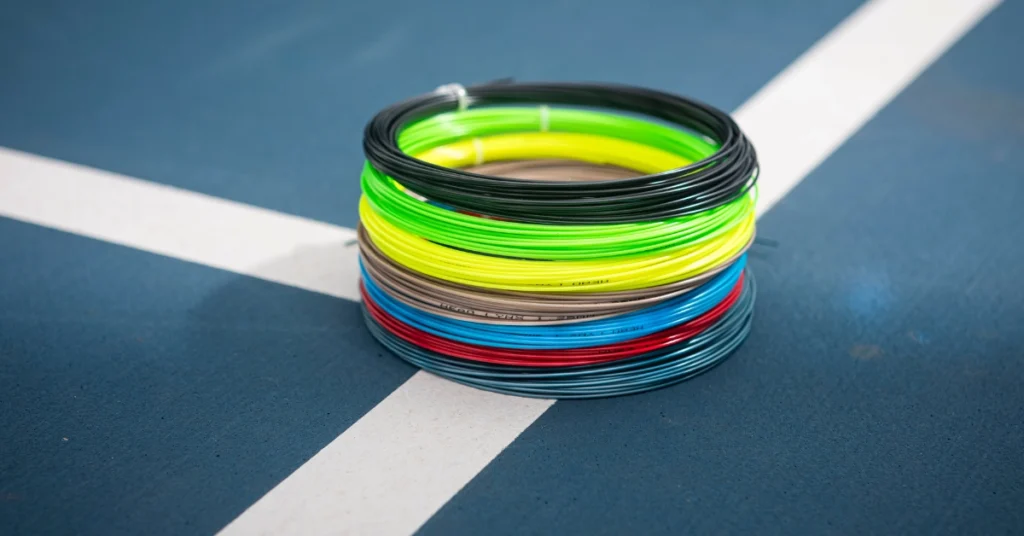
How to choose a tennis string – Your tennis racquet might be your weapon — but your strings are the engine. They decide how much power, spin, and control you have, and how your arm feels after a few sets. Whether you’re a beginner just learning to rally or a competitive player chasing precision, understanding strings can completely transform your game.
I’m Chris, an ERSA Pro Stringer and the founder of ProStrung. I’ve tested hundreds of strings across brands and player levels — and this guide will help you find the perfect setup for your game.
Why Your String Choice Matters
How To Choose A Tennis String – Most players spend hours researching racquets but almost no time thinking about strings — yet your string setup influences over 50% of how a racquet performs.
The right string can enhance your strengths and fix weaknesses (like adding spin, control, or comfort), while the wrong one can make even the best racquet feel harsh or unpredictable.
Your goal is to match your string’s characteristics — power, spin, control, and comfort — with your playing style and frequency.
The Four Key Factors When Choosing a Tennis String
| Factor | What It Means | Why It Matters |
|---|---|---|
| Material | Polyester, multifilament, natural gut, or synthetic gut | Defines your string’s power, spin, feel, and comfort |
| Gauge (Thickness) | Thinner = more spin, thicker = more durability | Impacts control and longevity |
| Tension | Looser = more power, tighter = more control | Fine-tunes your setup to your play style |
| Frequency of Play | How often you hit | Determines how often you’ll need to restring |
String Material Types Explained
Polyester
Best for: Advanced players who generate their own power.
These are the most popular strings on tour — designed for control, spin, and durability. They’re firm, predictable, and perfect for players with fast, confident swings.
✅ Pros: Spin, control, tension stability
⚠️ Cons: Firm on the arm, not ideal for beginners
💡 Examples: Luxilon ALU Power, Head Lynx Tour, HighString Zeus 2.0
Multifilament
Best for: Players seeking comfort and easy power.
Made from hundreds of microfibers, multifilaments offer excellent feel and a softer response. Perfect for players recovering from arm pain or those who prefer a plush, forgiving contact.
✅ Pros: Comfort, power, arm-friendly
⚠️ Cons: Less control, frays faster
💡 Examples: Tecnifibre Multifeel, Wilson NXT, Babolat Xcel
Synthetic Gut
Best for: Casual players and all-rounders.
The classic all-purpose option — crisp, responsive, and affordable. A solid step up from factory strings for those who play once or twice a week.
✅ Pros: Affordable, balanced performance
⚠️ Cons: Shorter lifespan than poly
💡 Examples: Solinco Pro Stacked, Prince Synthetic Gut
Natural Gut
Best for: Players who want the ultimate feel and power.
The premium choice, used by pros for decades. Natural gut offers unmatched comfort, power, and tension retention — ideal for hybrid setups with a poly string.
✅ Pros: Power, comfort, tension stability
⚠️ Cons: Expensive, less durable
💡 Examples: Babolat VS Touch, Luxilon Natural Gut
Where it really stands out is control on aggressive swings. There’s enough feedback to place your shots accurately, yet enough give to maintain comfort — a combination that few strings manage this well.
String choice by player level

| Player Type | What You Need | Recommended String Type |
|---|---|---|
| Beginner | Comfort, power, forgiveness | Multifilament or Synthetic Gut |
| Intermediate | Balanced spin and control | Hybrid setup or softer poly |
| Advanced | Precision and spin | Polyester or hybrid (poly + gut) |
| Competitive | Maximum control and durability | Firm, low-powered polyester |
Hybrid Setups: The Best of Both Worlds
Hybrid stringing often pairs polyester mains (for control and spin) with softer crosses (for comfort and power).
This setup gives you the best of both worlds — it’s what many pros, including Federer and Murray, rely on.
💡 Example combos:
Restring Zero + Restring Sync → Control + touch
Luxilon ALU Power + Babolat VS Touch Gut → Power + comfort
Tecnifibre Razor Code Soft + Babolat Xcel → Spin + softness
Finding the Right Tension
Your string tension changes everything.
| Tension | Effect | Feel |
|---|---|---|
| Lower (20–22kg) | More power, more comfort | Softer, livelier |
| Mid (23–25kg) | Balanced feel | Great starting point |
| Higher (26–28kg) | More control, less power | Firmer, crisper |
➡️ Pro Tip:
If you’re using polyester, start around 22–23kg.
For multifilaments or gut, go slightly higher at 24–26kg for consistency.
How Often Should You Restring?
Strings wear down long before they break. A general rule:
⏱️ Play twice a week → restring every 6–8 weeks
⏱️ Play three or more times a week → every 3–4 weeks
🧵 Polyester loses tension quickly, so don’t wait until it snaps!
Dead strings = less spin, less comfort, and more risk of arm pain.
Matching Your String to Your Racquet
| Example Racquet | Recommended String Type | Why It Works |
|---|---|---|
| Wilson Blade 98 | Firm control poly (Lynx Tour, 4G Soft) | Keeps power in check, enhances precision |
| Babolat Pure Aero | Spin poly (Zeus 2.0, Confidential) | Boosts natural bite and topspin |
| Yonex Ezone 100 | Softer poly or hybrid setup | Balances power and comfort |
| Head Speed MP | Control poly with good feel | Keeps depth consistent and responsive |
My Pro Tips as a Stringer
- Don’t chase pro setups — their frames and string tensions are customized for their swing speeds.
- Comfort first if you’ve ever had arm or shoulder pain.
- Experiment with tension before changing string type. Sometimes 1–2kg makes all the difference.
- Pay attention to your feel after 3–4 hours of play — it’s the best indicator if your setup suits your game
Final thoughts
Choosing the right tennis string doesn’t need to be complicated — it’s about finding what complements you. Your swing speed, racquet type, and comfort preferences all play a role. Start with your level and tweak tension or hybrid setups until it feels just right.
If you’d like personal advice, I’m always happy to help.
🎾 Message me on via chat, and we’ll find your ideal string setup.
