
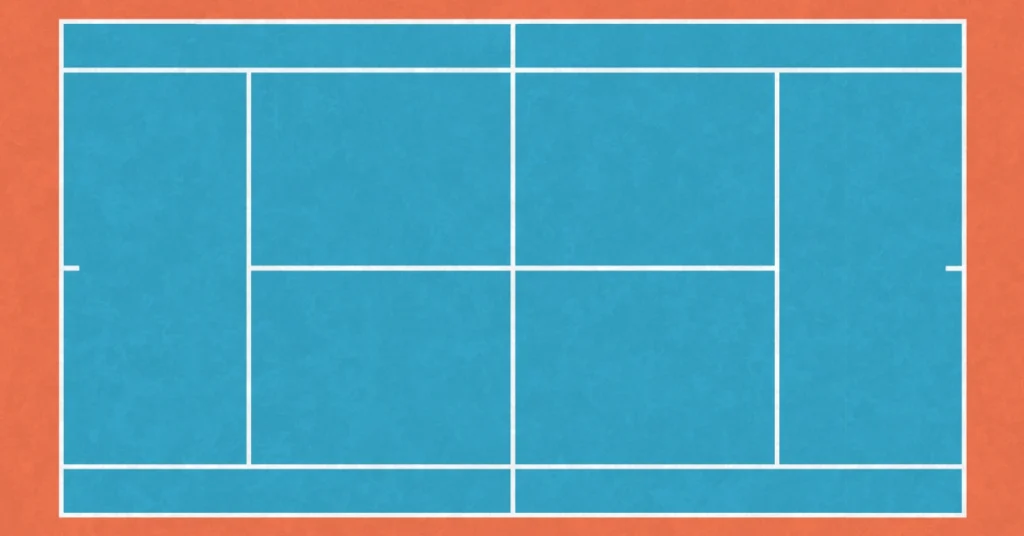
You’re not the only one who has ever watched tennis and asked how big is a tennis court. Court dimensions are very important to how tennis is played, whether you’re a casual player, a parent of a junior athlete, or just interested in the game’s design. The size of the court affects everything, from how you serve to how you move your feet.
In this guide, I’ll go over the official sizes of tennis courts, the sizes of doubles and singles courts, the height of the net, and the amount of space needed for run-off. You’ll know exactly how big a tennis court is and why that matters by the end.
Official Tennis Court Size (According to the ITF)
How big is a tennis court? A standard tennis court is 23.77 meters (78 feet) long and 8.23 meters (27 feet) wide for singles. For doubles, it is 10.97 meters (36 feet) wide. The whole playing area, including the space around the lines where the ball can run off, is usually about 36.6 × 18.3 metres (120 × 60 feet). The ITF sets these official sizes, and they are the same for all competitive courts, whether they are grass, clay, or hard.
Singles vs Doubles Court Size Explained
The only difference between a singles and doubles tennis court is the extra playing space on the sides, called the doubles alleys.
These alleys are:
- 4.5 ft (1.37 m) wide on each side
- Increasing the total width from 27 ft to 36 ft
Players often ask why doubles courts are wider. It’s simply to accommodate the extra player on each side, allowing more space for angling volleys, covering gaps, and creating dynamic patterns at the net.
Service Boxes: How Big Are They?
Tennis service boxes make up a crucial part of the court. Each service box is created by the centre service line and service line, dividing the court into four equal rectangles.
Each service box measures:
- 21 ft (6.4 m) long
- 13.5 ft (4.12 m) wide
Why this matters:
- A smaller box rewards precision on serves.
- A longer box affects how aggressive players can be with flat or slice serves.
- Kick serves benefit from the rectangular dimensions, giving the ball more room to bounce high.
Baseline & Centre Mark
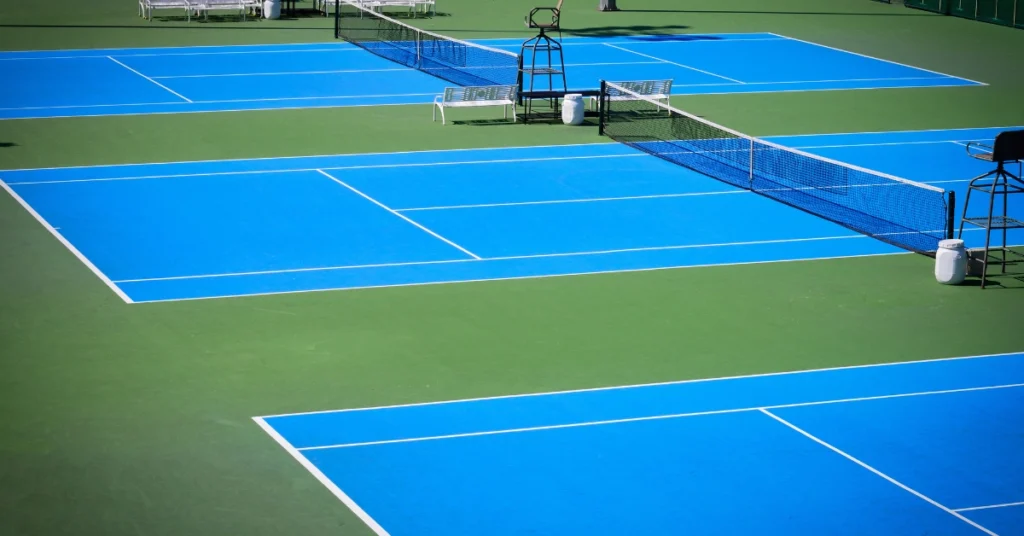
The baseline runs the entire width of the court:
- 27 ft for singles
- 36 ft for doubles
In the middle of the baseline is the centre mark, a small 4-inch line that helps players position themselves during the serve. It may look insignificant, but it plays an important role in:
- Determining legal stance during the serve
- Helping players align for accuracy
- Maintaining consistency in serving routines
See my blog on US Open Prize Money here.
The Net & Net Height

The net isn’t the same height all the way across. It is 3 feet (0.914 m) high in the middle and 3 feet 6 inches (1.07 m) high at the posts. The dip in the middle isn’t an accident; it makes hitting across the court easier, cuts down on mistakes at the lowest point, and changes the way rallies go in both singles and doubles. This lower center height is also one of the reasons why most baseline exchanges naturally move across the court.
Total playing area vs. full court area
The playing court itself is only 78 × 36 ft at its biggest, but the area needed for proper play is much bigger. The ITF says that a full space should be 120 ft (36.6 m) long and 60 ft (18.3 m) wide, with enough room for players to run off safely. This extra space helps prevent injuries when chasing wide balls, enables players to generate greater power and angles, and supports the movement required for tournament-level rallies.
Professional courts, like those at Wimbledon or the US Open, usually have even more space, especially behind the baselines. See my blog on US Open Prize Money here.
Different Court Surfaces — Same Size
No matter the surface, the dimensions remain identical:
- Grass (Wimbledon)
- Clay (Roland Garros)
- Hard court (US Open / Australian Open)
However, surface type affects the perception of space, because:
- Grass plays fast, reducing reaction time.
- Clay plays slow, making the court feel larger.
- Hard courts balance both.
So while the physical size doesn’t change, your experience on each surface absolutely does.
Is a Pickleball or Padel Court the Same Size?
No — and this is where people get confused.
| Sport | Court Size |
|---|---|
| Pickleball | 44 ft × 20 ft |
| Padel | 65.6 ft × 32.8 ft (20 m × 10 m) |
Compared to tennis, pickleball courts are tiny, and padel courts are enclosed and more compact.
In summary
A tennis court is:
- 78 feet long
- 27 feet wide for singles
- 36 feet wide for doubles
- With additional run-off space making the full area roughly 120 x 60 feet
But the beauty of tennis is that within these fixed dimensions, thousands of playing styles thrive — from baseline grinders to serve-and-volley artists.

3 thoughts on “How Big Is a Tennis Court? Full Dimensions & Measurements”