
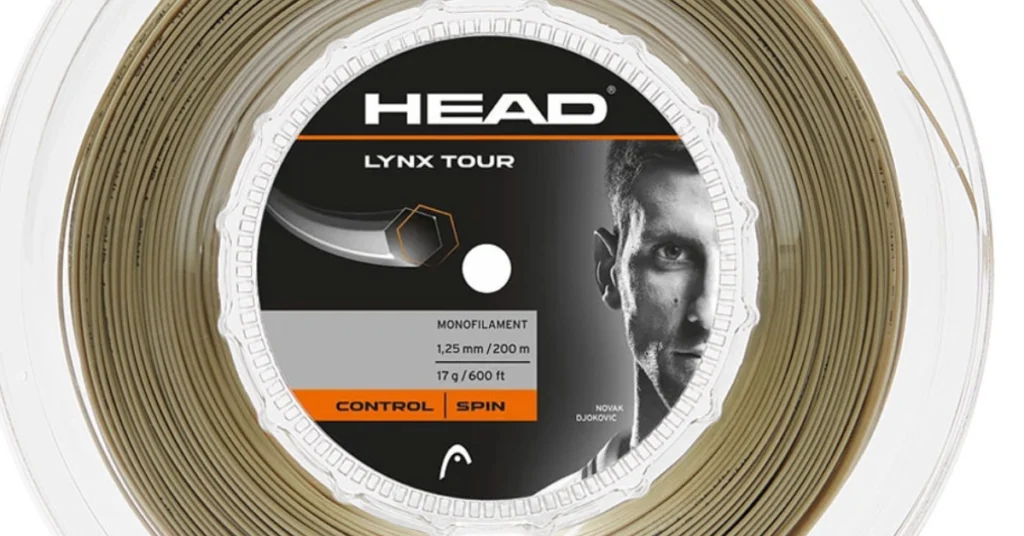
Head Lynx Tour tennis string is a shaped co-poly designed to bring together control, spin, and durability in one string. I strung it (in 1.25 mm) and hit it on court to see exactly how it behaves under real conditions. Below is a breakdown of how it performs, where it excels, its trade-offs, and which players might benefit most.
Quick verdict
Lynx Tour tennis string is a high-control, spin-capable poly that leans toward precision rather than raw pop. It’s not for players who want an ultra lively string — but for those who swing big and demand command, it offers an excellent balance of grip, stability, and longevity.
What the numbers and lab tests say
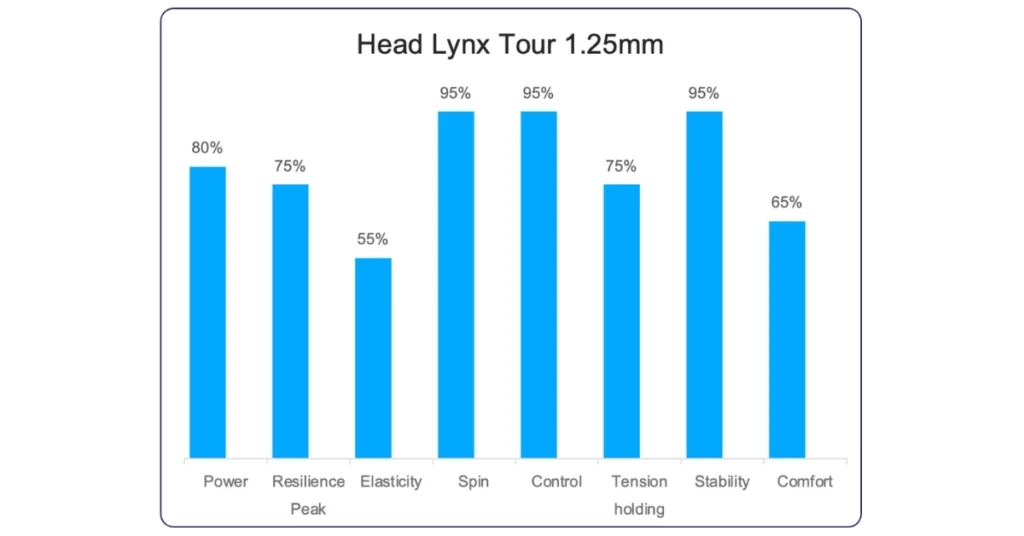
Lab testing of Head Lynx Tour tennis string 1.25mm (Champagne colour) highlights its two standout qualities — spin and control, both rated at 95%. This pairing makes it a dream string for aggressive baseliners who want to take big swings while keeping the ball inside the lines.
The shaped profile helps the string bite into the ball, while the firm, consistent response ensures excellent directional accuracy. For players who thrive on heavy topspin rallies or precision placement, these numbers show why Lynx Tour tennis string is one of Head’s most popular performance polys.
Backing up those headline stats, stability also scored 95%, confirming the string’s ability to stay solid under pressure from pace and long rallies. Alongside this, tension holding (75%) is above average for a poly, meaning Lynx Tour doesn’t suffer from the sudden “fall off a cliff” feeling that plagues many co-polys. The string remains consistent across multiple sessions, making it a dependable option for regular hitters who want reliable performance over time.
In terms of liveliness, power came in at 80% and resilience at 75%, suggesting Lynx Tour is not a dead poly. There’s enough built-in punch to keep shots penetrating, without ever feeling uncontrollable. That said, elasticity (55%) is on the lower side, so it won’t provide much natural rebound, and comfort (65%) is only moderate — firm enough to be playable but not the softest choice for sensitive arms.
👉 Overall: The lab numbers position Head Lynx Tour tennis string as a control-and-spin specialist with excellent stability and above-average tension holding. It’s not the softest or bounciest option, but for players who value precision, consistency, and heavy spin, it delivers tour-level reliability.
How it plays (feel, spin, power, control)
On court, Lynx Tour tennis string has a crisp, firm feel, but with enough “give” to avoid feeling overly harsh. It doesn’t mush, and feedback is clean. The shaped edges help with snapback, making spin easier without having to overcompensate your swing.
Spin is reliable — you can generate heavy topspin and effective slices, particularly if your stroke mechanics are sharp. The control is excellent: you’ll notice you can aim at tight targets with confidence, especially on aggressive swings. The saved energy (less raw pop) helps keep balls in play rather than overshooting.
That said, because it’s not a lively string, you need to produce your own speed. For players who already swing fast, that’s not an issue; for those with compact swings, you might miss some zip.
Durability & tension maintenance
Lynx Tour shines in durability and maintaining playability over time. With a durability rating of 91 and playability duration 83, it outperforms many standard polys in its staying power. In practical terms, that means after multiple sessions the stringbed doesn’t feel drastically different — you won’t experience that sudden “dead spot” or loss of control that many polys develop mid-life. See my guide here on choosing the right tennis string tension.
Fraying and notching are modest, and the string resists breakage well, especially for a control poly. The tension loss is gradual, not abrupt, meaning the feel evolves more smoothly rather than falling off a cliff. For players who like their string setup to behave predictably rather than wildly as it ages, Lynx Tour is a strong option.
Who it suits
Best For:
- Intermediate to advanced players who prioritize control and precision over raw pop
- Big swingers who want a “safe” string for redirecting shots or taming pace
- Players who don’t want to restring every few hours and value durability
Not For:
- Beginners or players with slower swings who rely on string power
- Players who want maximum softness or “trampoline” feel
- Those needing light, forgiving polys for elbow or shoulder sensitivity
Best suited racquets
Given Lynx Tour’s strengths — excellent control, reliable spin, and strong tension holding — it pairs best with racquets that reward precision and consistent ball striking. Open-pattern, spin-oriented frames like the Babolat Pure Aero, Head Extreme MP, or Yonex VCORE are natural fits, as the string amplifies their spin potential while keeping shots safely inside the lines.
In more control-focused racquets such as the Wilson Blade 98, Head Prestige Tour, or Yonex VCORE Pro, Lynx Tour adds an extra layer of spin and depth, helping open up angles without compromising the racquet’s inherent stability. For tweener racquets like the Wilson Clash 100 or Yonex Ezone 100, Lynx Tour works well to rein in excess power and provide sharper directional accuracy.
In short: Lynx Tour shines in spin-friendly and control-oriented frames, and it’s best suited to intermediate and advanced players who want a dependable poly that balances spin and precision over multiple sessions.
🎾 Head Lynx Tour Racquet Pairing Guide
| Racquet Type / Feature | Why Lynx Tour Works Well | Watch Outs / Notes |
|---|---|---|
| Spin-oriented / open-pattern frames (e.g. Babolat Pure Aero, Head Extreme, Yonex VCORE) | These frames already encourage spin and looseness — Lynx Tour’s shape and control will capitalize on that, giving you bite without sacrificing precision. | May feel firmer, so dialing tension down 1–2 lbs or using a softer cross string helps. |
| Control / precision frames (e.g. Head Prestige Tour, Wilson Blade 98) | These tight-pattern, stable frames benefit from the added snap and spin that Lynx Tour delivers, helping you open up angles or flatten shots with confidence. | Frame + string firmness can become stiff; hybrid setups help soften feel. |
| Tweener / balanced frames (e.g. Yonex Ezone 100, Wilson Clash 100) | Lynx Tour helps rein in excess power and give better directional control, while still providing spin potential — a good match for players wanting to balance power and control. | You may lose some of the frame’s natural pop; choose tension thoughtfully. |
Comparable strings
To help you see where Lynx Tour fits in the landscape, here’s how it compares to several other notable strings:
- Restring Zero: Zero offers more liveliness and a bit more forgiveness, but Lynx Tour surpasses it in control and tension longevity.
- Luxilon Savage Blue 127: Savage is a sharper, livelier string — Lynx Tour tennis stringtrades some of that edge for steadier feel and better durability.
- Mayami Tour Hex Blue 123: Mayami leans more aggressively toward spin with its hex profile; Lynx Tour is more balanced, giving up a little spin punch for more control stability.
- Luxilon Eco Power Green 125: Eco Power is greener (eco-friendly) and tends to live longer, but Lynx Tour offers crisper feel and better control at the expense of a slightly shorter lifespan.
In short: Lynx Tour tennis string doesn’t always win on one metric, but it provides a very reliable all-round performance with a control advantage that many players will prefer.
Practible recommendations
Tension: Use your standard poly tension to start. If you want more “pop” or ease on serves, ease off 1–2 lbs. If you want more control, tighten by a couple of pounds — but don’t overdo it or it can get harsh.
Hybrids: Lynx Tour works particularly well in the mains when paired with a softer multifilament or synthetic gut in the crosses. That hybrid setup softens the touch a little while keeping the spin/control benefits of the poly mains.
Restringing: Because Lynx Tour’s tension falloff is gradual rather than sudden, you have a more usable window. For players who hit 2–3 times per week, a restring every 3–5 weeks is reasonable. Heavy hitters or those playing daily might want to restring more often to preserve crispness.
I hope this review gave you a clear picture of how Head Lynx Tour tennis string, who it suits, and what to expect from it over time. If you’d like advice on whether Lynx Tour (or another string) is the right fit for your game, or you’re ready to book a restring, just get in touch via chat!
