
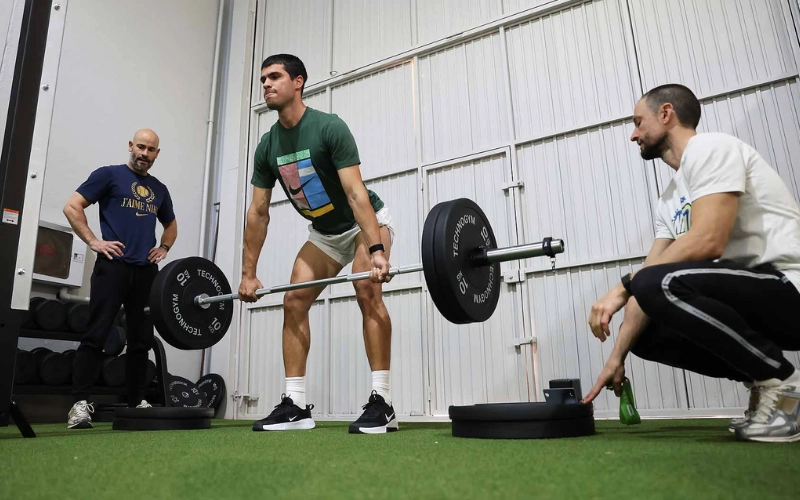
Carlos Alcaraz Training – Carlos Alcaraz closed the 2025 season at the top of the ATP rankings, capping a year defined by eight tour titles, an impressive 71-match win season, and continued dominance across surfaces. Now, with the 2026 season on the horizon and a coveted Australian Open title still missing from his résumé, the Spaniard has shifted into off-season mode — and his December training carries big implications for his prospects in the year ahead.
Back to Work in Murcia — Elite Preparation Begins
Carlos Alcaraz Training – On December 24, 2025, official ATP Tour coverage captured Alcaraz deep in training back in his hometown region of Murcia, Spain, as he prepares for the 2026 campaign. Photographs and reports show him working on hard courts, intensifying his fitness and on-court drills — a signal that his off-season won’t be a vacation but a serious push toward peak performance.
This period of training follows a historic season for the 22-year-old. Already a six-time major champion, Alcaraz stands just one Slam away from completing a Career Grand Slam, having won Roland Garros, Wimbledon and the US Open — all before his 23rd birthday [1].
Adjusting After a Coaching Split
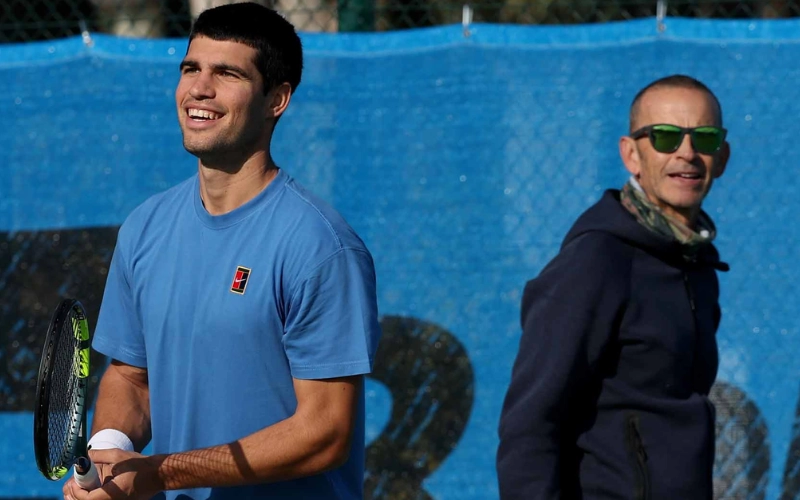
Carlos Alcaraz Training – Perhaps the most talked-about backdrop to Alcaraz’s current training block is his recent split with long-time coach Juan Carlos Ferrero. The pair, who had worked together since Alcaraz was 15, ended their partnership in December 2025 after a remarkable run that included 24 titles under Ferrero’s guidance and two ATP Coach of the Year awards.
Ferrero’s influence on Alcaraz’s development was profound: he helped the young Spanish phenom evolve from a powerful junior into a complete all-court weapon. Though the breakup was described as mutual and amicable, Ferrero has said publicly that the split was emotionally difficult for him, hinting at just how close their relationship had become.
With the split now official, Alcaraz’s training in December featured longtime assistant coach Samuel López in a guiding role. López, who has been part of the coaching team for several seasons and stepped into greater responsibility throughout 2025, is expected to serve as interim head coach into 2026.
Focused Training with Intelligent Partners
Carlos Alcaraz Training – Off-season prep isn’t just about solo fitness; it’s also about quality practice and strategic sparring. Reports from Marca reveal that Alcaraz has enlisted Italian player Flavio Cobolli as his main training partner during the preseason. Cobolli’s game provides an excellent measuring stick for Alcaraz — a close friend and a high-level pro who can push him through extended practice sets.
Aligning with elite training partners not only sharpens match rhythm but also helps simulate competitive intensity. This kind of thoughtful preparation suggests Alcaraz isn’t easing into the off-season — he’s pushing for continued evolution.
Carlos Alcaraz Training – Structured Pre-Season Block
Carlos Alcaraz Training – According to Marca and other tennis news outlets, Alcaraz’s pre-season will span about 25 days, stretching into early January before he departs for exhibition matches and then the official tour season. His schedule reportedly balances physical conditioning, technical refinement and tactical play development to ensure he’s firing on all cylinders ahead of the Australian summer.
Matches against other top players in exhibitions — including plans to play Jannik Sinner in Seoul, South Korea — are part of the calendar before the official 2026 season begins. These opportunities provide Alcaraz with competitive tune-ups against elite opposition, crucial in a landscape where margins at the top are razor-thin.
Training Even on Holidays
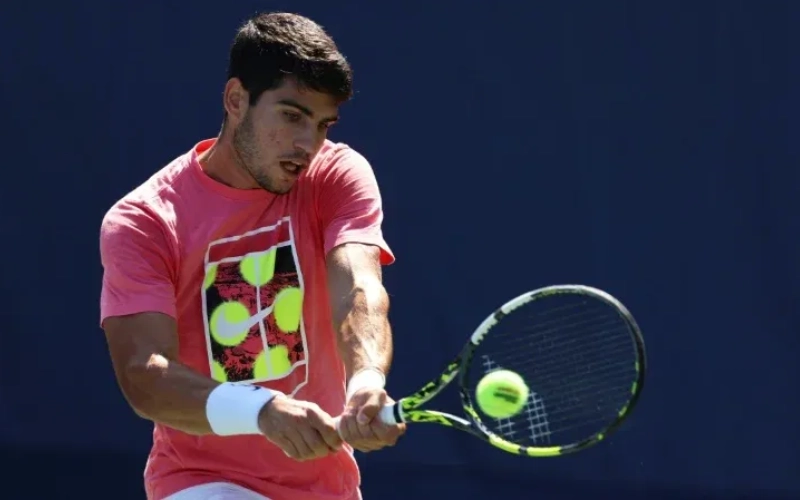
Carlos Alcaraz Training – One image that’s captivated fans and media alike is of Alcaraz training on Christmas Eve — a powerful visual reminder of his commitment. Despite the timing and backdrop of family holiday rituals, the Spaniard chose to hit the court, combining both dedication and discipline in equal measure.
This willingness to work even on days many take off highlights Alcaraz’s mindset: he knows that maintaining his World No. 1 status — and imminently capturing the one missing Grand Slam (the Australian Open) — requires more than just talent. It requires relentless preparation.
Balance: Physical, Technical and Tactical Edges
Alcaraz’s training philosophy appears comprehensive. Rather than isolating fitness or shots, his camp integrates:
Alcaraz’s off-season work isn’t “gym week” then “hitting week” — it’s a blended system. His camp layers physical development, technical repetition, and match-tempo exposure so every session feeds the next. Click each pillar to expand the exact focus, what it improves, and what it looks like on court.
Pillar 1 Physical conditioning Strength • Speed • Endurance
The goal isn’t “bigger” — it’s repeatable explosiveness: faster first steps, stronger deceleration, and an engine that holds up when rallies turn brutal.
Focus areas
- Strength + power: force production for heavier ball + serve pop.
- Speed + change of direction: acceleration, braking, re-acceleration.
- Aerobic base: recovery between points and day-to-day load tolerance.
- Injury resilience: hips, ankles, groin, shoulder integrity.
What it changes in matches
- Later-set speed stays high (less “leg drop”).
- More aggressive court positions because he trusts the reset.
- Cleaner defense-to-offense transitions.
Pillar 2 On-court technical repetition Patterns • Spin • Serve
This is where “good shots” become automatic. Reps are built around patterns he’ll actually use under pressure — not highlight-reel experiments.
What gets drilled
- Forehand patterns: inside-out pressure, heavy cross to open the court, then strike.
- Backhand reliability: depth targets + change-up timing to avoid neutral rallies.
- Spin precision: same swing shape, different trajectories (high heavy vs. drive).
- Serve placement: repeatable spots (T / body / wide) + second-serve kick quality.
Why it matters
- Lower error rate when he plays fast.
- More “free points” via serve patterns, not just speed.
- Better shot selection because patterns are pre-programmed.
Pillar 3 Match-rhythm exposure Tempo • Pressure • Timing
Gym fitness and clean reps don’t automatically equal match sharpness. This pillar builds decision speed and timing under pressure — the stuff you can’t fake.
How they simulate it
- Practice sets with scoreboard pressure and specific tactical constraints.
- High-calibre partners to keep ball speed and patterns realistic.
- Exhibition tune-ups to re-introduce adrenaline + crowd tempo.
What it upgrades
- Return timing vs bigger serves.
- First-ball patterns (serve +1 / return +1).
- Clutch execution because “tight moments” are rehearsed.
Goals: Australian Open and Career Grand Slam
Carlos Alcaraz Training – At the forefront of Alcaraz’s targets is the Australian Open — the sole Grand Slam title evading his collection. Having fallen in the quarters the previous year to Novak Djokovic, his December prep centers on peaking at Melbourne Park, where conditions favour hard hitting, swift movement and topspin depth — staples of his aggressive baseline game.
Completing a Career Grand Slam would cement Alcaraz’s place among the sport’s all-time greats, and the meticulous nature of his winter training block signals he’s approaching this goal with intent.
Mental Approach — Embracing Growth
Carlos Alcaraz Training – Alcaraz’s 2025 showed both brilliance and areas for reflection — notably the loss at Wimbledon and the close rivalry with players like Jannik Sinner and Novak Djokovic. Tennis insiders note that the off-season is as much about mental preparation as physical readiness — reinforcing resilience, tactical clarity, and match-play aggression.
His decision to return home for this block, instead of extended travel or rest, reflects a player purposefully positioning himself to grow rather than merely maintain.
Looking Ahead: A New Era With 2026 Targets
Carlos Alcaraz Training – As training progresses into January, all eyes will be on how Alcaraz transitions from off-season work to match competition. His preparation suggests a player fully engaged in refining his craft, sharpening his tools, and bolstering his tactical edge.
With the Australian Open approaching, Alcaraz’s December training is more than routine — it’s a statement of intent. If his work in Murcia and exhibition outings translate into peak performance once the tour resumes, fans may well see one of the most complete seasons of his career yet.
If you enjoyed this breakdown, you might also like my article on Emma Raducanu’s Switch to Uniqlo.
