
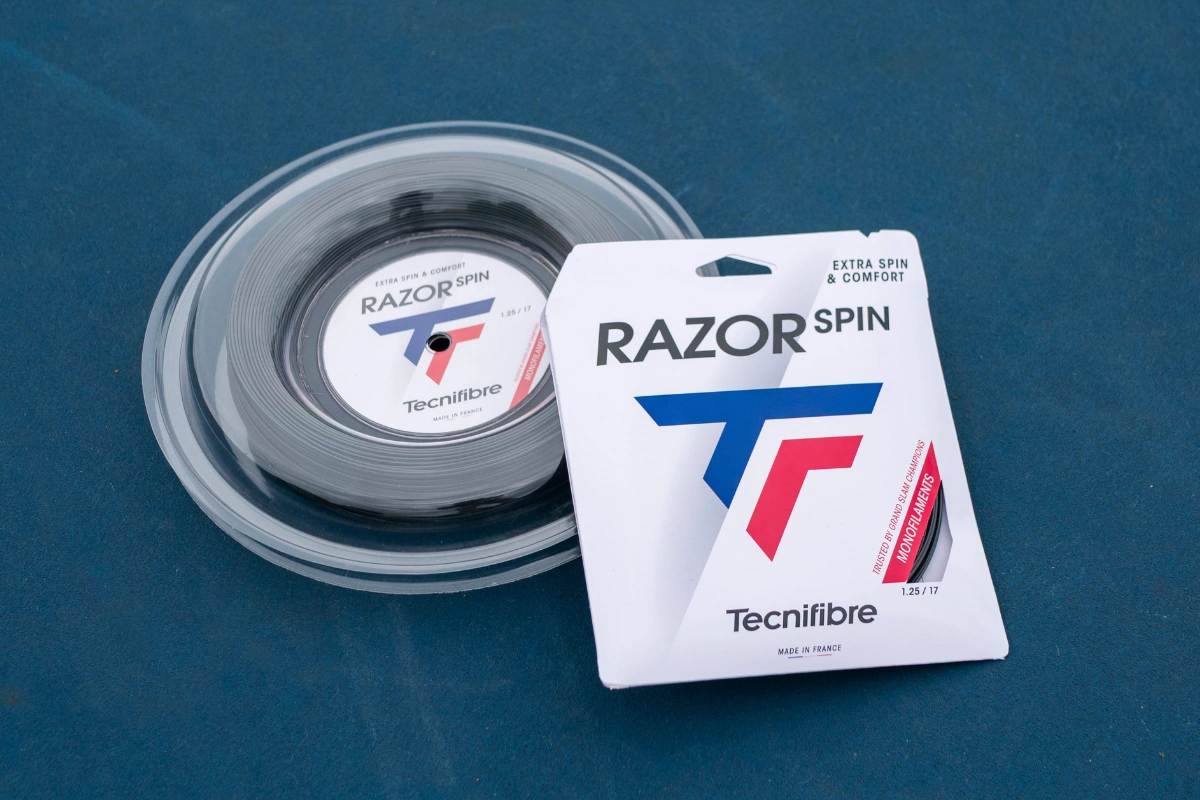
Tecnifibre Razor Spin Review – Tecnifibre positions Razor Spin as the new member of the Razor family: a monofilament co‑poly built around precision, spin and comfort. Like Razor Soft, it uses a high‑modulus co‑polyester core for control, with polyurethane (PU) additives blended in to soften the feel and improve comfort and vibration damping.
The big differentiator is the square cross‑section with sharpish edges designed to “bite” the ball more and harness your racquet’s natural power into heavy spin. Tecnifibre recommends it primarily for racquets over 300g, with a suggested tension window around 22–25 kg.
Quick verdict
Tecnifibre Razor Spin Review – If you like the sound of Tecnifibre Razor Soft but always wished for more “grab” and spin on the ball, Razor Spin is exactly that lane. The square profile and PU‑infused construction give you classic Razor control and a pretty comfortable ride for a shaped poly, but with noticeably easier access to spin than most round co‑polys.
In the Blade 98 it felt like a modern, crisp control string with a predictable launch and easy, “honest” spin when I accelerated; in the Head Speed MP it turned the frame into a very complete all‑court setup where I could flatten out, roll heavy, or carve angles without feeling like the string was getting in the way. It’s not a rocket launcher or a plush noodle, but if you bring racquet‑head speed and like to work the ball, it’s a very compelling option.
What the numbers say – Tecnifibre Razor Spin
Tecnifibre Razor Spin Review – Tecnifibre has not published a full lab sheet for Razor Spin yet, but I include stats below to give you and indication based on playtests.
Tecnifibre Razor Spin — Performance Scores
How it plays (feel, spin, power, control)
Feel
On impact Razor Spin sits in that “modern firm‑but‑not‑brutal” category: crisper than a soft poly/multi, but with a touch more give and dwell time than a really stiff spin string. That lines up with the design brief of high‑modulus co‑poly plus PU additive for comfort.
In the Blade 98 16×19, the feel was connected and fairly direct, but there’s a slight smoothing of the shock that you don’t get from very dry, glassy polys – I never felt any jarring even when I caught the ball higher in the hoop on defense. In the Speed MP, the response was a little livelier and more elastic, but still on the controlled side; I always felt like I knew where the ball was going.
Spin
Spin is the obvious headline. The square profile and sharp edges are there specifically to increase ball rotation, and Tecnifibre’s own language leans hard into Razor Spin’s ability to “bite” the ball and generate heavy, pushing‑you‑back spin.
On court, that shows up less as a super‑loopy, high‑arc trajectory and more as easy grip and heavy, penetrating spin when you swing with intent. In the Blade I could really drag the ball cross‑court and still get it down inside the line; in the Speed MP, mid‑court forehands were fun – I could roll them aggressively without feeling like they’d fly. If you just poke at the ball you won’t suddenly get free RPMs, but once you accelerate, the string moves and snaps back efficiently.
Power
Razor Spin sits in the medium‑low power band: not as dead as an ultra‑firm control poly, but clearly tuned for control first. That’s consistent with the high‑modulus co‑polyester core and Tecnifibre’s positioning of it as a string for precision players rather than players looking for free power.
In the Blade, which is already a low‑ish powered frame, I had to supply my own pace – which I quite like – and the reward was depth that I could dial in swing after swing. In the Speed MP, the combination felt more “neutral”: I had enough pop for aggressive baseline tennis, but the string never tipped into wild or over‑lively, even when I flattened out on shorter balls.
Control
Control is one of Razor Spin’s clear strengths. Tecnifibre explicitly markets it for players looking for precision and comfort, not just raw spin, and the high‑modulus core is there to keep trajectories surgical when you swing big.
The launch angle felt very predictable in both test frames – I didn’t have those mystery balls that suddenly rocket long once the string beds in. In the Blade 98, I really trusted myself to swing through targets on the backhand and hit to lines; in the Speed MP, I found it easy to take big cuts on return and still keep the ball within a tight window.
Pros and Cons – Tecnifibre Razor Spin Review
Tecnifibre Razor Spin Review – Here’s a quick pros and cons snapshot for Tecnifibre Razor Spin:
Durability & tension maintenance
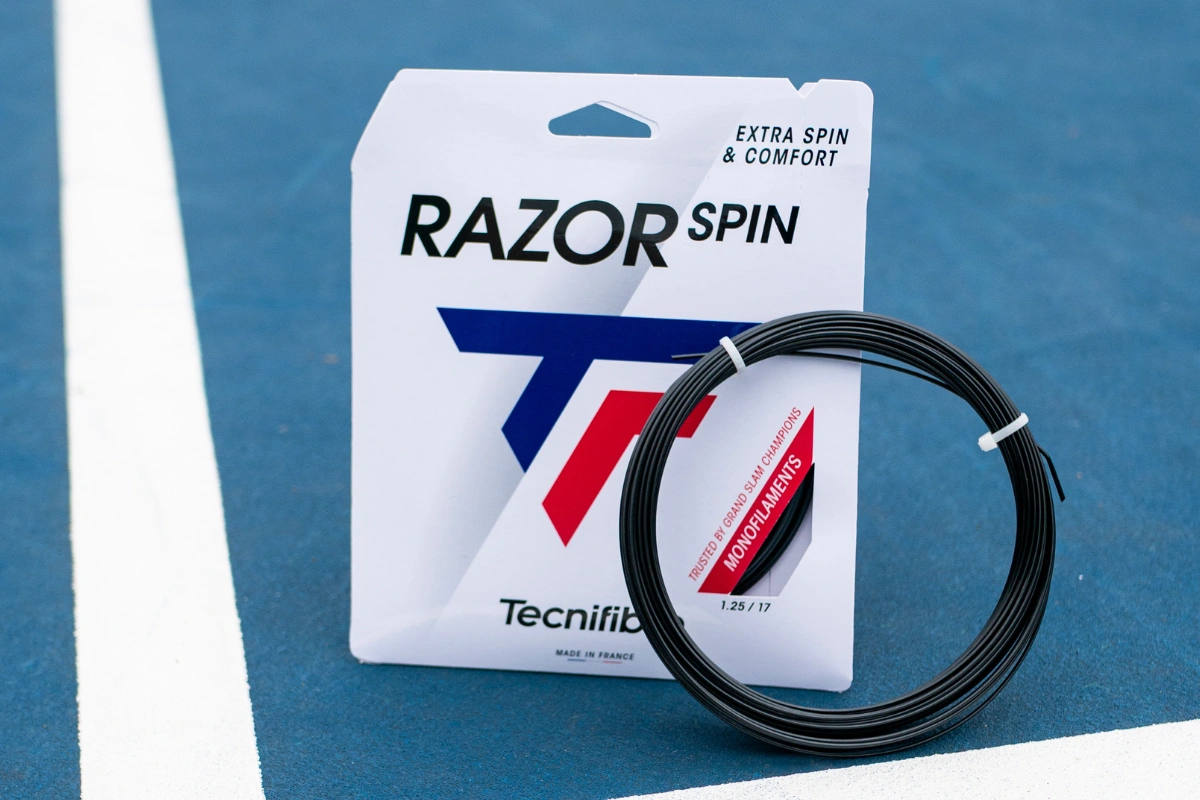
Tecnifibre Razor Spin Review – There’s no dedicated lab sheet yet, but both Tecnifibre and retailers highlight good playability duration and a construction designed to keep performance more stable over time than older‑generation polys. The high‑modulus core and the way the PU is integrated seem to help the string maintain its character rather than going from crisp to mushy overnight.
In practice, in both the Blade 98 and Speed MP I found that Razor Spin held its feel and launch pattern nicely through the normal poly window – it slowly lost some bite and pop rather than falling off a cliff. For regular string breakers in this category, I’d look out for thicker gauges once they’re available.
WHAT YOU SHOULD READ NEXT
10 Best Hybrid Tennis String Setups for 2026: The Ultimate Guide to Spin and Control
Ready to level up your gear? We rank the top hybrid combinations for 2026, from explosive spin masters to rock-solid precision setups…
Who it suits
Best For:
- Intermediate to advanced baseliners who swing with intent and want spin plus directional control.
- Players who like Razor Soft / Razor Code’s precision but want more bite and help with spin.
- All‑court players who appreciate a connected, modern poly feel without going to a brutally stiff string.
Not For:
- Players with arm issues who do better on multifilaments or very soft co‑polys.
- Lower‑speed swingers who rely on the string for easy depth – you’ll likely find it a bit too controlled in low‑powered frames.
- Anyone who prefers a very muted, plush response over a crisp, feedback‑rich string bed.
Best suited racquets
Tecnifibre specifically recommends Razor‑family strings for racquets over 300 g, which gives you a clue about the intended user: modern player frames and controlled tweeners.
From my testing and what the construction suggests, Razor Spin fits particularly well in:
Good fits include:
- Head Speed MP – balances the frame nicely for all‑court play; adds spin and control without killing feel.
- Wilson Blade 98 (16×19) – classic match: the Blade’s flex and feel pair really well with Razor Spin’s precision and bite.
- Spin‑oriented but fairly powerful tweeners (Pure Drive / EZONE 100‑type frames) where you want to rein in launch angle and add more confidence on big swings.
- Modern 98s and 100s with open patterns (VCORE 98, Pure Strike 16×19, etc.) if you want a shaped poly with more comfort than the really stiff “tour” offerings.
Comparable strings to Tecnifibre Razor Spin
Tecnifibre Razor Spin Review – If you are considering Tecnfibre Razor Spin, you might also want to look at:
Comparable Strings — How They Stack Up
Real-world comparison (not lab data) — where Tecnifibre Razor Spin sits relative to some popular shaped and control polys.
Practicable Recommendations – Tecnifibre Razor Spin Review
For Razor Spin, a good starting tension is also in the 21–23 kg range, nudging up or down depending on how powerful your frame is and how much launch you like. In more powerful 100 sq in tweeners or if you swing big, you can comfortably creep towards the 23–24 kg end for a lower, more controlled trajectory, whereas in lower‑powered 98s or if you want a bit more pocketing and depth, sitting at 21–22 kg keeps things friendlier.
In terms of set‑ups, Razor Spin makes the most sense as a full bed if you want to feel its full identity: sharp spin, clear feedback and a modern, controlled response. If you like the spin and precision but want to soften things slightly, pairing it with a softer cross (a softer round poly or a multi/syn gut) can smooth the feel and add a touch of comfort without completely losing that square‑profile bite.
If you enjoy these string reviews and find them useful, consider buying me a coffee. It helps fund future testing and gives me the time to bring you more honest, in-depth reviews

