
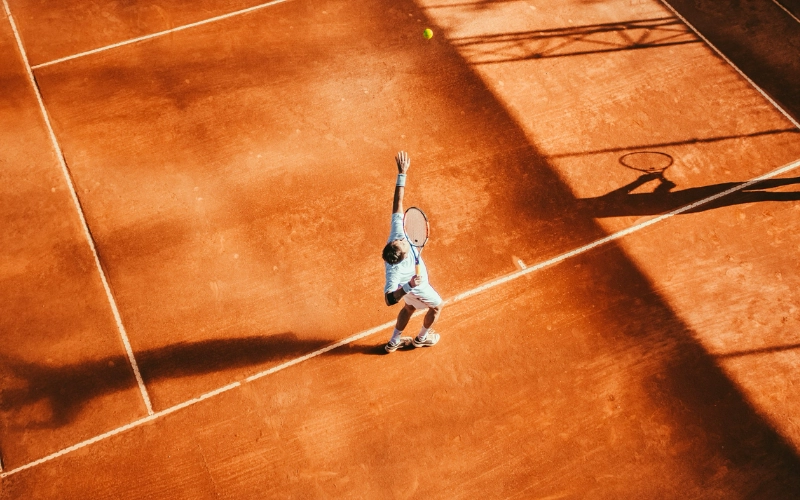
What Is an Ace in Tennis? While playing tennis, there are few activities that cause the same satisfaction as hitting an unreturned serve for an ace. Whenever I see the opponent not even touch the ball, I feel some of the most simple joy I can experience on the tennis court. Simply put, an ace happens when the player that serves the ball is not ever returned. The point is only given to the player that serves the ball as the opponent does not touch the ball.
However, an ace is much more than just getting a free point. It serves as a weapon, a psychological tool, and a statement of dominance. Why is that? Let’s exam the reasons.
What Is An Ace In Tennis?
In order for a ball to be considered an ace, certain precise standards need to be upheld.
- A legal serve must touch down within the designated service area (or on the corresponding boundary line for the box).
- An ace must be a serve that the opponent does not contact during the serve. Otherwise, it is a service winner (if they contact the ball) but never considered an ace.
- An ace cannot be a let serve, meaning the serve submitted should not have hit the net.
What this means is that a server must hit the exact service box, and the opponent should not be able to (or chooses not to) hit the ball while it is bouncing on (or after) the first and second bounces during play.
This is done by the achievement of an ace. Predictably the risk-taking serve, is done with exact control, soft and quick touches, while also not overworking the entirety of the court.
Why aces matter
What explains the phenomenon of the ace in tennis? There are multiple explanations.
- Momentum & Psychology
An ace in tennis is akin to throwing a punch in a boxing match. It sends the signal that you are able to dominate a point at will. For the receiver, it is sending a message that is very discouraging. In psychological terms, the receiver is losing confidence. If I did not even see or touch that serve, I have no chance to win the point. For the server, it is a confidence boost.
- Efficiency
Securing an advance point on the serve saves on energy and shortens the overall length of the point. This contributes to “holding serve” more easily. This is particularly true on faster courts (grass, indoor hard) where ace counts can be huge indicators of server advantage.
- Statistical Marker
In professional tennis ace counts are recorded and are often used as indicators of player’s serving capabilities. A player who is able to hit a lot of ace counts is considered a strong server. The records are astonishing, such as the record held by John Isner, a legendary server, who once hit 113 aces in a single match.
- Tactic & Strategy
In order to achieve ace serves, players serve with a combination of speed, placement, disguise, spin, and timing and it results in the ball being hit unplayably. This is often done with a wide serve, body serve, down the T flat serve, or serving to the sideline.
How To Get An Ace
Let’s break down the craft of the ace. What does a player need?
- Speed / Pace: A serve that is fast gives the returner less time to react. Naturally, the faster the serve, the higher the ace potential.
- Placement / Angle: Placing the serve near the edges of the service box (wide, close to the line, body serve) means less court left for the opponent and more chance of miss-hit.
- Variation / Disguise: If the server uses the same serve repeatedly, the returner gets predictable. Variation in serve type (flat, slice, kick) and direction keeps the opponent guessing.
- Surface & Conditions: Some courts make aces more likely. For example, grass and fast indoor hard courts favour big servers; slower clay courts make aces harder.
- First Serve Risk: Many aces come on the server’s first serve, because they can afford to go for more power and risk. On the second serve, the server usually plays safer and thus fewer aces.
Ace vs. Service Winner: Know the Difference

Two widely used terms that may cause confusion are ‘serve winner’ and ‘ace’. A serve that results in a point win and is touched by the opponent in an unsuccessful attempt is a ‘serve winner,’ while an ‘ace’ is a serve that is not touched at all. This distinction is subtle but important when compiling stats.
In a casual viewing of a game, one may hear an announcer cry, “Ace!” in reference to a singular, unreturned volley. Although the volley is technically an ace, the announcer is mainly drawing from the strict cultural definition of the term and is certainly not wrong in doing so.
Why the Term “Ace”?
Where did we get the term “ace” in tennis? The exact origin is murky, but here are accepted theories:
- One theory links the term to playing cards: the “ace” card often represents one of the most powerful cards in a game — the serve that is unbeatable is similarly powerful.
- Another suggests it stems from the older term in serve-and-volley games: “ace” meaning a single, one-shot point.
- While no official single origin is confirmed, the meaning is clear: a shot so good the opponent doesn’t touch it — a one-shot winner.
The Flip Side: Limits & Caveats
Aces are fantastic, but they are not the whole picture. Here are some factors to consider:
- It is not the only factor in the game. Someone who serves a lot of aces but also serves a lot of double faults or is weak on their returns may wind up losing.
- On some serve slower surfaces, or when facing a really good returner, there may not be as many acers. Thus, the game may require other serve stratagies.
- Some aces may happen when the receiver is slow or mispositioning to serve. Thus, it might be more due to the opponent’s weakness than the success of the serve.
- Since aces are clean points, it can speed up the match. However, it also speeds up match without allowing the server to create patterns or test the return game of the opponent.
Final Serve: Why the Ace Captures Our Imagination
An ace is a dramatic phenomenon. The server puts their foot back in the stance, tosses the ball in the air, swings the racket, and then perhaps, while holding their breath, the opponent steps in time. Silence. The ball bounces once and then twice, and the point is over. The ace is the phenomenon in minute. Instant gratification in a sport defined by ball-to-ball contact and long rallies, there is a stark contrast between effort and result.
An ace is a true testament to the athletic theater and a microcosm of the sport. The one on one battle pitting mind vs mind where the margins for victory are razor thin and the stakes are extremely high. Then along comes an ace, and the server is able to think, breathe, and stand just a little bit taller because they know that in this point, they had the edge.
In club matches and across the world, spectators and players alike appreciate the phenomenon that is the ace for a variety of reasons. Despite hoping to make an ace themselves, they get to appreciate one of the most climactic moments in the sport. The ace is admiration and athleticism in one.
And with a little bit of luck on the server’s side, an ace can be the defining point of a match. So the next time you see an ace, whether in person or on TV, take a minute and appreciate the shot one more time.
And now you know exactly what makes an ace a special shot. I hope you enjoyed this guide — if you did, you might also like to read my article on What Is a Break Point in Tennis?

2 thoughts on “What Is an Ace in Tennis? Definition, Rules, Strategy & Famous Examples”