
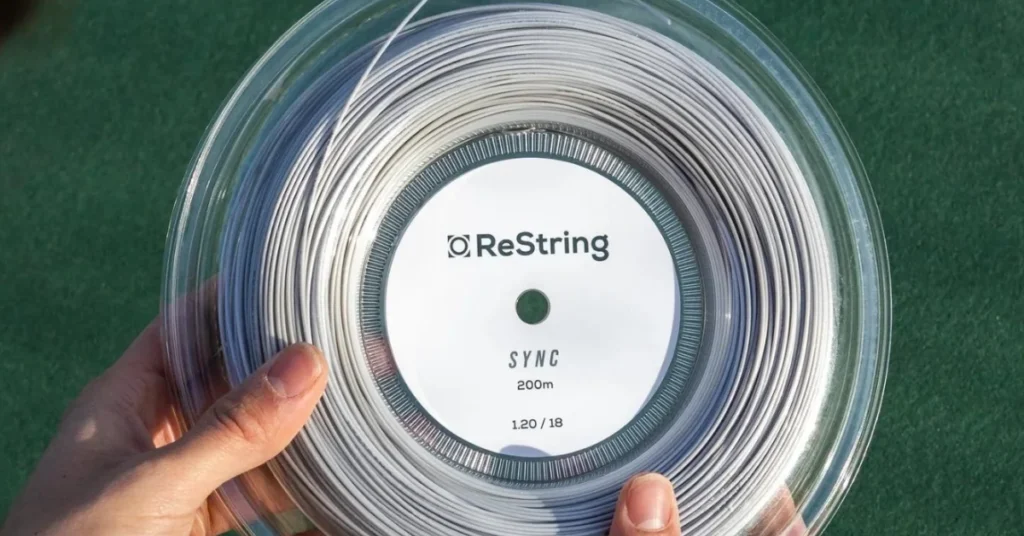
Restring Sync is a co-polyester string positioned as a modern all-rounder — one that blends spin, control, and comfort while staying user-friendly for a wide range of players. After stringing and testing it, plus looking at lab results, here’s how it stacks up against the competition.
Quick verdict
Restring Sync tennis string is a spin and control-focused poly with above-average comfort for its class. It’s not as brutally firm as Luxilon ALU Power, and it’s a touch softer than Weiss Cannon Silverstring, while still offering strong spin and reliability. It’s a smart choice for players who want modern poly performance without going to extremes on stiffness or liveliness.
What the numbers and lab tests say
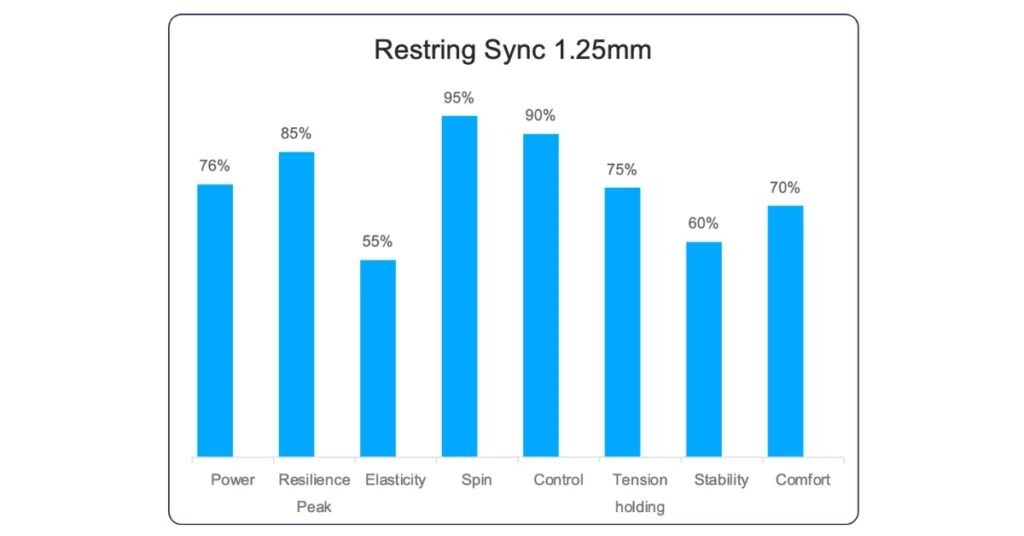
Lab testing shows that spin (95%) and control (90%) are Restring Sync’s standout qualities. These scores reflect how the string grips the ball and rewards fast, confident swings. For baseliners who rely on heavy topspin and directional accuracy, this combination makes Sync a very dependable option.
Power (76%) and resilience (85%) are solidly above average, meaning Sync isn’t a dead-feeling string — it provides enough pop to keep rallies lively while still letting you dictate the pace. However, elasticity (55%) came in low, suggesting it doesn’t offer much natural rebound compared to softer polys.
In terms of durability, tension holding (75%) is respectable, keeping performance consistent over multiple sessions without a sudden drop-off. Stability (60%) is one of the weaker points, hinting that under heavy incoming pace the stringbed may not feel quite as rock-solid as some firmer options. Finally, comfort (70%) rates better than average for a poly, giving Sync a more forgiving feel than ultra-stiff control strings.
👉 Overall: The numbers point to Sync as a spin and control specialist with playable comfort and decent power, best suited to players who value precision but don’t want to punish their arm in the process.
How it plays (feel, spin, power, control)
On court, Restring Sync tennis string has a smooth feel at impact — crisp but not overly harsh. Spin potential is immediately noticeable, as the ball grips well against the stringbed and snaps back reliably. Kick serves jump, topspin shots dip sharply, and slices stay low. Control is another strength: you can swing big and still trust your shots to land inside the lines.
Power sits comfortably in the middle ground. It won’t overwhelm you with free depth, but you don’t have to work overly hard either. Comfort is decent for a co-poly — firmer than a multifilament or hybrid, but easier on the arm than Luxilon ALU Power or Weiss Cannon Silverstring when strung at the same tension.
Durability & tension maintenance
With a tension holding score of 75%, Sync holds up well compared to many polys in its class. Performance remains steady for multiple hitting sessions, with a gradual loss of tension rather than a dramatic cliff drop. Durability is fair for a 1.25mm gauge — not a tank, but resistant enough to last through solid use unless you’re a chronic string breaker.
That said, stability at 60% means it won’t feel quite as solid against heavy hitters as firmer tour-grade polys. If you play with a lot of pace or face big servers often, you may notice the stringbed softening under pressure sooner than expected. See my guide here on choosing the right tennis string tension.
Who it suits
Best For:
- Intermediate to advanced players who want spin and control without excessive stiffness
- Baseliners looking for a balance of power and precision
- Players who need a poly that won’t beat up their arm
Not For:
- Heavy string breakers who need maximum stability and durability
- Beginners who would benefit more from a multifilament or synthetic gut
- Players who prefer an ultra-firm, dead poly response
Comparable strings
If you’re considering Restring Sync tennis string, here’s how it stacks up against some well-known competitors:
- Weiss Cannon Silverstring 1.25 – A legendary control poly with a firmer, deader response. Silverstring offers more precision but less comfort and liveliness compared to Sync.
- Head Lynx Touch 1.25 – Softer and more elastic, offering higher comfort and pocketing feel. Lynx Touch has less raw spin and control, but it’s more arm-friendly for players coming from softer strings.
- Luxilon ALU Power 1.25 – The gold standard for control and stability, but far stiffer and harsher on the arm. ALU Power delivers more bite under pace, while Sync offers a more forgiving and playable option.
👉 In short: Sync is less harsh than ALU Power, softer than Silverstring, and more spin-focused than Lynx Touch, making it a versatile middle ground among control polys.es a very reliable all-round performance with a control advantage that many players will prefer.
Practible recommendations
Tension: Start with your usual poly tension. If you want to maximize comfort, drop it 2–3 lbs; if you want tighter control, raise it slightly.
Hybrids: Works well in a hybrid with a soft cross like synthetic gut or multifilament for extra comfort.
Restringing: Expect to restring every 3–4 weeks if you play 2–3 times per week. Competitive players may want to restring more frequently to keep spin and control at their best.
I hope this review gave you a clear picture of how Restring Sync tennis string, who it suits, and what to expect from it over time. If you’d like advice on whether Sync (or another string) is the right fit for your game, or you’re ready to book a restring, just get in touch via chat!
