
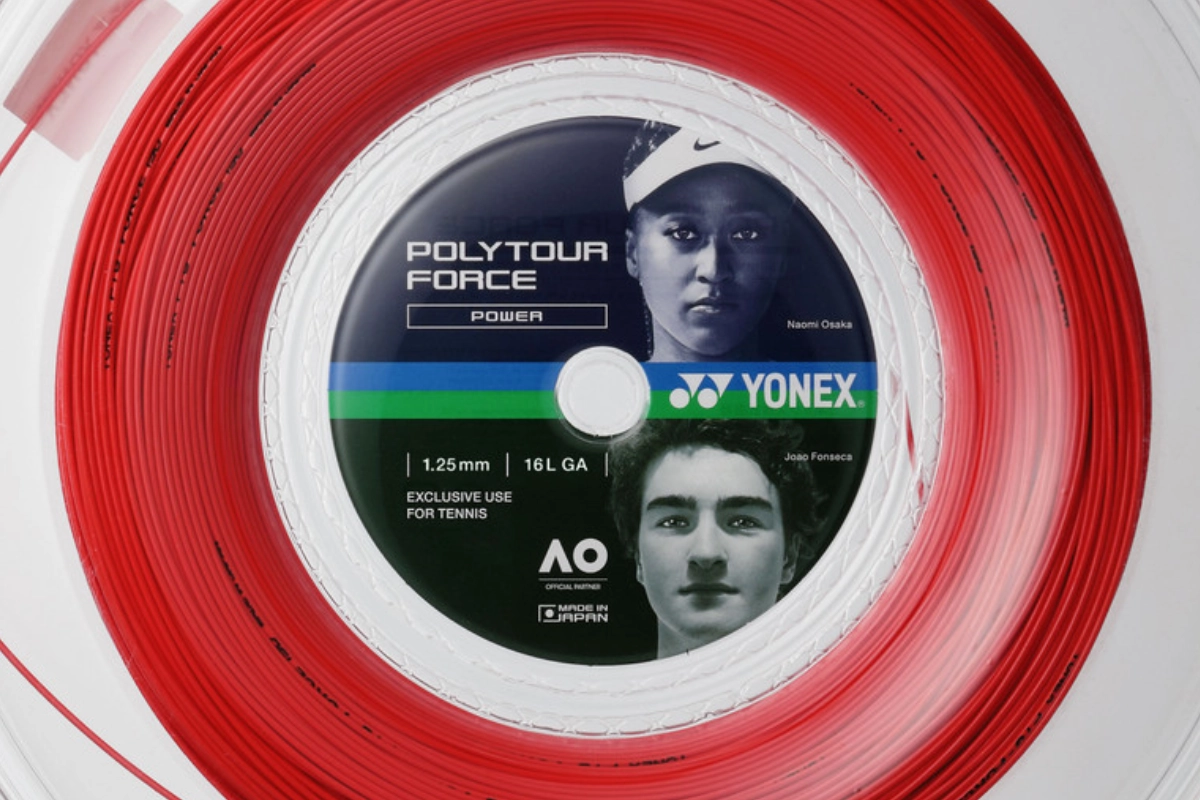
Yonex Poly Tour Force is a softer, power-friendly co-poly that’s built for players who want something more forgiving than those rock-hard control polys, but without sacrificing that solid structure or shot-making confidence. It carves out a nice middle ground: livelier and comfier than the Poly Tour Strike, but way more dialed-in and predictable than the Pro.
Quick verdict
Yonex Poly Tour Force gives you controlled power with a noticeably softer, more forgiving feel than most performance polys. The response off the strings is smooth—not some wild explosion—with solid directional accuracy and a comfortable thud that holds up nicely over long sessions. Spin’s respectable but not over-the-top, and tension maintenance is better than average for something power-leaning.
👉 Ideal if you want a softer-feeling poly that still plays composed and predictable. Not ideal if you’re chasing maximum RPMs or a dead, ultra-linear control response.
What the numbers say
Note: Yonex hasn’t published lab measurements as yet. The scores below Yonex Poly Tour Force are indicative based on playtests, spec, and comparisons with similar shaped co-polys.
Yonex Poly Tour Force — Performance Scores
👉 In short: Yonex Poly Tour Force leans toward controlled power and comfort, with respectable spin and better tension stability than many softer polys.
How it plays (feel, spin, power, control)
Feel
On court, Poly Tour Force felt noticeably smoother and more forgiving than firmer Yonex strings like Poly Tour Strike. The impact has this nice cushioned response without ever going mushy, and you get a clean, connected feel right through the ball. It doesn’t pocket dramatically, but it completely avoids that harsh, tinny sensation some power polys pick up after a few hours.
Power
Power level sits at a solid medium-plus for a poly. I found depth came pretty easily once I committed to the swing, but it never felt twitchy or unpredictable. It’s that controlled, linear kind of pop—you get out exactly what you put in, without any surprises.
Spin
Spin’s respectable but not the star of the show. Being a round poly, it leans more on string snapback and your own racquet speed than aggressive edge bite. Heavy topspin hitters can still rack up good RPMs, but it’s not a ball-carver like Hyper-G or Hepta-Plus.
Control
This is where Poly Tour Force really impressed me. Directional accuracy felt locked in, especially on flatter drives and when I was attacking the lines. The launch angle stays medium and super consistent, which made it easy to trust my targets set after set.
Pros and Cons
Yonex Poly Tour Force – Here’s a quick pros and cons snapshot for Yonex Poly Tour Force:
Durability & tension maintenance
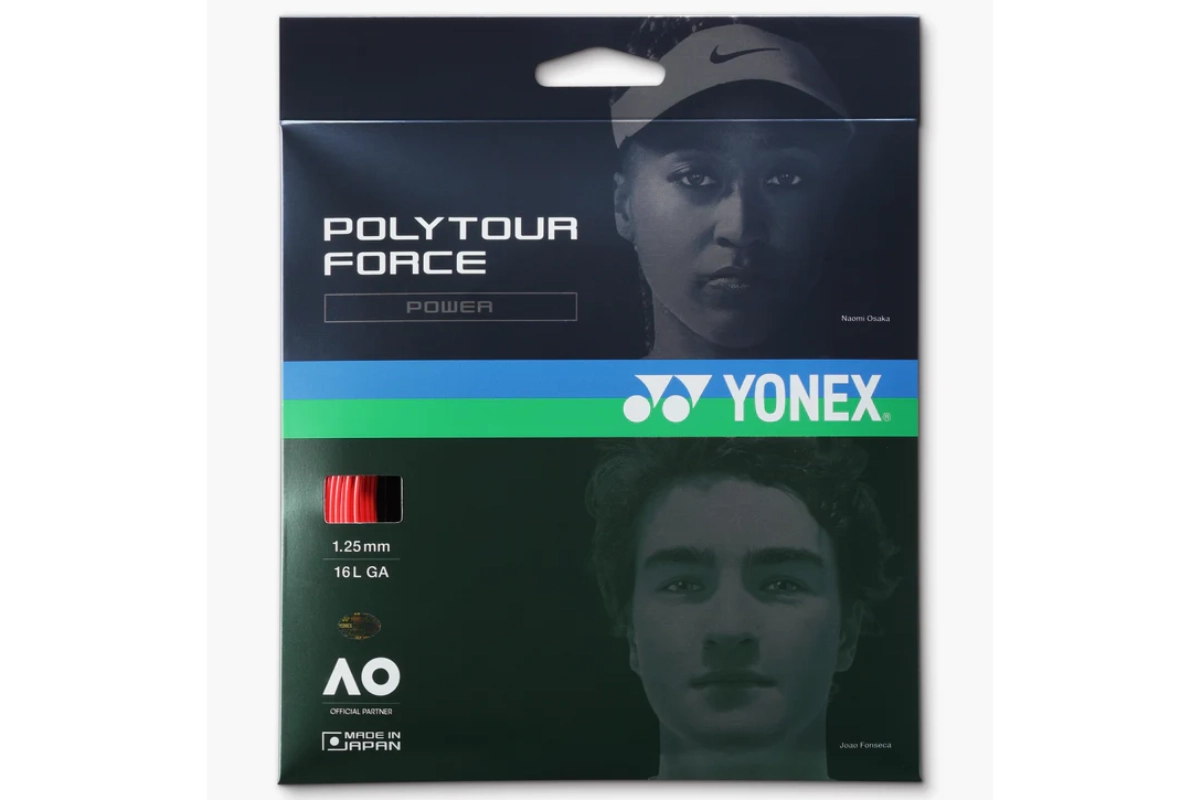
Yonex Poly Tour Force holds its performance better than most softer polys, but it’s still not a marathon string.
Playability phases:
- Fresh (0–4 hrs): Smooth, controlled power with excellent feel and confidence on full swings.
- Mid (4–10 hrs): Very stable window — launch angle stays consistent and feel remains predictable.
- Late stage: Gradual softening rather than a cliff-drop. Power creeps up slightly, but control remains usable longer than expected.
👉 Poly Tour Force doesn’t fall apart suddenly. If you value gradual decline over sudden loss of control, this string performs well. See my guide here on choosing the right tennis string tension here.
Who it suits
Best For:
- Intermediate to advanced players who want controlled power with comfort
- Players transitioning from multifilament or softer polys
- All-court baseliners who mix spin and flatter drives
- Players sensitive to overly stiff stringbeds
Not For:
- Spin-first players chasing maximum RPMs
- Flat-out string breakers who want ultra-firm response
- Players who prefer very low launch, dead control polys
Best suited racquets
Yonex Poly Tour Force works best in modern control or balanced frames where its power and feel can shine without becoming floaty:
- Yonex EZONE 98 / 100 — adds control and structure to a naturally powerful frame
- Yonex VCORE Pro 97 / 100 — brings needed pop and comfort
- Wilson Blade 98 (16×19) — softens feel while keeping directional accuracy
- Head Speed MP / Pro — smooths out response and improves comfort
In very open or powerful frames, consider stringing slightly higher to maintain launch discipline.
Comparable strings
If you are considering Yonex Poly Tour Force, you might also want to look at:
Comparable Strings — “Overall Fit” Snapshot
Real-world comparisons (not lab data) — how Yonex Poly Tour Force stacks up against close alternatives.
Practible recommendations
Tension: 22–24 kg (48–53 lbs) is a strong starting range for most intermediate to advanced players. If you want a firmer, more locked-in response, go +1 kg. If you want to lean further into comfort and pocketing, drop 1 kg.
Gauge: 1.25 mm is the safest all-round pick and where Poly Tour Force feels most balanced. Go thinner for a touch more feel and launch, thicker if you want extra stability and durability.
Setup: Best as a full bed if you want a controlled, connected power response with good comfort. If you want a bit more bite or a firmer feel, it also works well in a hybrid with a shaped poly or firmer control cross.
Restringing: Tension holding is a strength here, but it’s still a poly. Expect a consistent response for longer than most power polys, and cut it out once the feel goes flat or the ball stops responding cleanly—don’t wait for it to go completely dead.
If you enjoy these string reviews and find them useful, consider buying me a coffee. It helps fund future testing and gives me the time to bring you more honest, in-depth reviews


Hey Chris,
How does it compare to polytour strike in terms of Feel, Spin, Power and Control ?
Strike got removed for this and was the best string out of the polytour lineup by far for me.
Yes Strike is a nice string. So Strike is firmer, with a tad more control. Poly Tour Force definitely feels softer and more plush to me and more powerful with a bit more feel than Strike – I think Spin is fairly similar (not much in it but haven’t tested in many frames yet). I think Force will work well with some firmer shaped and spin orientated strings potentially e.g. RPM Blast. Chris
hello Chris, do you think this new PT Force is suited also for the new vcore 98?
what strings would you suggest for that frame?
i’m not a string breaker and use a normal amount of spin, actually my usual string is the tecnifibre razor soft 1.25 lime color at 21-20 or 22-21
You could try Poly Tour Force, maybe at 21/20 kg. However, if you want that “connected” feel you currently have, the Poly Tour Pro is the more natural transition from Razor Soft.
What is it about the Razor Soft that you’re looking to change, or are you just looking for a better color/brand match for the new Yonex?
thanks Chris for your reply, i’m not looking for anything in particular, just curious about new yonex string that i read around seems designed for the new vcore line.
i dont really like the polytour pro on recents yonex frames, i used it in the past on dr98 with good results, but on ezone 100 2022 i never liked it. maybe cause meantime i went progressively down with tension and the PTP isnt built for so low tensions?
do you think trying out the Force would need to go up 1kg at 22-21 due a less stiff structure than the razor soft (that is only soft against the standard razor code), or i can keep it at my mostly used 21-20 ?
my perception is that i could raise to 22-21 the razor soft cause the vcore98 seems “eat” the string faster than for example my ezone98, where starting at same 21-20 tension i could keep playing with a fair amount of control and stability compared to the vcore where the loss of tension seems to have more influence after the same hours of play.
so what the main differences i should note between Force and razor soft ?
Poly Tour Force has a unique structure designed for high snapback. At very low tensions (21/20), it might feel a bit wild on a VCORE 98, which already provides plenty of launch. Compared to Razor Soft, Force is more elastic. While Razor Soft is “soft” for a control string, Poly Tour Force is “firm” (despite the name). If you keep Force at 21/20, it will likely feel much more “launchy” than the Razor Soft did at the same tension.
so i should go atleast up to 22-21 if want try the Force on the vcore98, right ?