
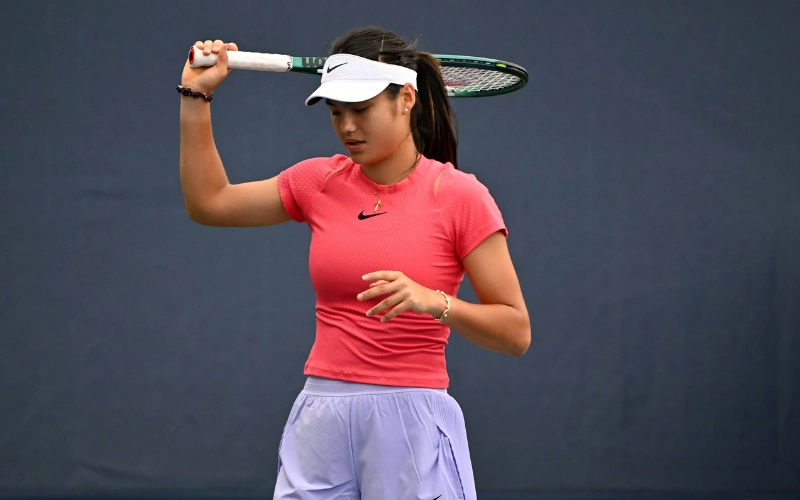
Emma Raducanu is at a pivotal moment in her career — and she isn’t just playing more tennis. She’s strategically building a better Raducanu. After a breakthrough 2025 campaign highlighted by consistency, grit, and grinding through her busiest season ever, the British No. 1 is focused on strengthening her body, mind, and tactical game for 2026 with new coach Francisco Roig leading the charge.
In 2025, Raducanu played 50 professional matches across 22 tournaments — the most she’s ever contested in a single year — and finished ranked No. 29 in the world. That marked a return to form and consistency she hadn’t enjoyed since her 2021 US Open title run, and set the stage for an offseason dedicated to transformation rather than maintenance.
The Roig Effect: Smart, Not Just Hard
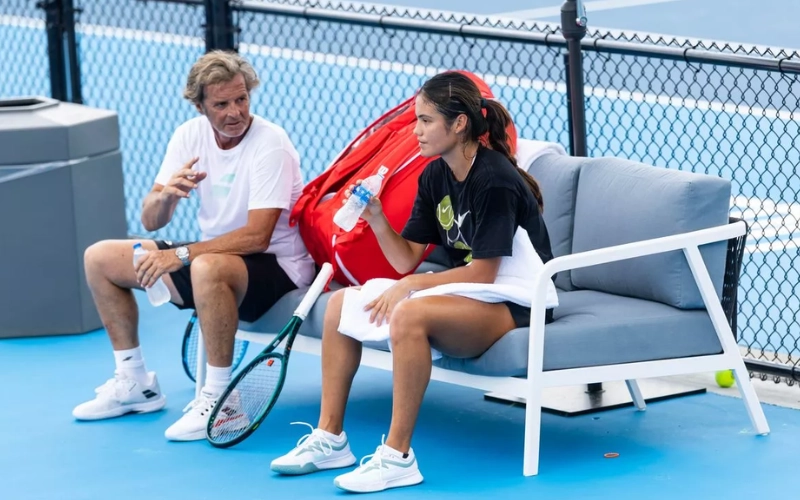
The major storyline heading into 2026 is Emma’s work with Francisco Roig [1], a coach long associated with tactical excellence and massive experience on the WTA and ATP Tours. Roig isn’t there to overhaul Raducanu’s style, but to sharpen it — building a more complete competitor capable of executing her best tennis under pressure.
What does that mean?
- Improved baseline strength: Raducanu’s two-handed backhand is already world-class, but Roig wants her to use it even more reliably as a go-to weapon rather than as a reactive shot.
- More options in her game: A great tennis player is predictable with variety — not just aggression. Roig is helping Emma build a toolkit that includes depth, disguise, and court geometry.
- Less overthinking: Raducanu has always been a cerebral player, often trying to exploit opponents’ weaknesses. The focus now is on executing her own aggression first, not solely counter-playing others.
The goal isn’t cosmetic change — it’s clarity under pressure. She wants to see patterns earlier, decide faster, and finish points with greater conviction.
Pre-Season in Barcelona: Conditioning Meets Strategy
Building a Better Raducanu – Raducanu’s 2026 pre-season isn’t happening in isolation — she’s training at altitude in Barcelona, tapping into elite physical work and high-intensity tactical drills with Roig and her team.
But this is more than fitness:
- Footwork refinement: To help her movement stay explosive later in matches.
- Strength building: To ensure her body can hold up through longer rallies and multi-week events.
- Point construction drills: To embed strategic shot selection under fatigue.
Part of building a better Raducanu is also smart scheduling. After playing more than 50 matches in 2025 — and managing foot and back niggles toward the end of the season — she’s hinted that she’ll play less overall in 2026 to protect her body and peak more often.
Beyond Fitness: Mental Strength and Tennis IQ
Building a Better Raducanu – Raducanu’s evolution isn’t purely physical. She’s spoken about becoming more robust — mentally and tactically — which shows a maturity not often seen even in established pros. She is aware that tennis at the top level isn’t won by raw athleticism alone but by decision-making speed, pattern recognition and mental resilience.
Her offseason emphasis on mental structure is clear:
- Shorter memory: Win or lose, she’s training to reset quickly.
- Clear tactical profiles: Before matches, she’s developing game maps for likely exchanges.
- Decision prioritization under duress: In crunch moments, knowing which shot to take.
That’s the kind of refinement champions display — and it’s a pillar of building a better Raducanu.
Addressing Weaknesses: Tactical Gaps and Adjustments
Building a Better Raducanu – No elite player is without weaknesses, and part of Raducanu’s 2026 vision is honest assessment. Her 2025 season had moments where she struggled against top-10 pace and consistency, particularly on returns when opponents controlled depth early.
So the focus now includes:
- Return of serve precision: Not just returning deep, but returning with aggression that disrupts opponent rhythm.
- Serve consistency: Maintaining first serve percentages even when under pressure early in sets.
- Better rally initiation: Choosing when to rally and when to take control early in the point.
These are subtle but critical gaps that, if improved, turn a very good player into a title contender.
How Francisco Roig Is Building a Better Raducanu
ROIG APPROACH
How Francisco Roig Is Building a Better Raducanu
A structured breakdown of what Roig is likely prioritising with Emma — physically, mentally, and tactically — plus what his Nadal-era habits suggest about the process.
🧠 1) “Smart, Not Just Hard” — The Roig Operating System
What he’s working on
- Clarity under pressure: fewer “maybe” decisions, more first-option conviction.
- Identity-first tennis: build points around her strengths before “solving” the opponent.
- Pattern simplification: repeatable A/B patterns that hold up when legs go.
How it shows up in training
- Constraint drills: limited target zones to force clean geometry.
- Scoreboard reps: pressure games (30–30, deuce, set points) to rehearse “one shot at a time”.
- Decision-speed blocks: reduce time between recognition → choice → swing.
Nadal-era learnings Roig likely brings
Roig’s Nadal background points to a philosophy of repeatable patterns + emotional control: build points with margin, win the physical battle without rushing, and use clear routines so the mind stays calm when matches get ugly.
🏋️♀️ 2) Physical Build — Durability, Explosiveness, “Late-Match Legs”
Physical priorities
- Baseline strength: hold ground vs top pace without bailing out early.
- Explosive movement: first-step + recovery steps so she stays dangerous under fatigue.
- Resilience: reduce niggles via better load distribution and movement efficiency.
Weekly structure (example)
- 2× strength: lower-body + trunk stiffness for stable hitting base.
- 2× speed: short sprints, lateral bursts, decel mechanics.
- 2× aerobic top-up: repeat-sprint ability for long rallies and long weeks.
What “Nadal-style” physical work means (without copying Nadal)
The takeaway isn’t “train like Rafa” — it’s train for repeatable chaos: high-output bursts, quick recovery, and staying technically clean when tired.
🎯 3) Tactical Upgrades — Patterns, Depth, Disguise, Court Geometry
What gets sharper
- Backhand as a “go-to”: proactive weapon, not just a response.
- Depth as default: build points with heavy, safe depth before pulling trigger.
- Options without chaos: variety that stays predictable (to her) under pressure.
Signature Roig drills (style)
- 2-ball rules: first ball deep, second ball aggressive to a set pattern.
- Cross-to-line sequences: earn the line change with depth and shape.
- Finish training: “short ball = mandatory action” to build killer instinct.
Match translation
You’ll see quicker pattern recognition, fewer neutral balls in key moments, and more points won by geometry — not just highlight-shot brilliance.
🚀 4) Serve + Return — The “Free Points” Department
Serve focus
- First serve % with intent: not just “in”, but “effective in”.
- Patterns off serve: serve location + first groundstroke as one unit.
- Second serve safety: avoid double-fault spirals under scoreboard stress.
Return focus
- Early contact: take time away vs top pace.
- Disruption returns: deep middle, sharp angle, or body — not random.
- First two shots: return + next ball rehearsed as a mini-pattern.
Why this matters
These are the easiest places to add wins without “playing better tennis” for 2 hours. Improve serve/return efficiency and the whole match feels simpler.
🧱 5) Mental Build — Short Memory, Faster Decisions, Calm Routines
What’s being trained
- Reset speed: win/lose point → next point unchanged.
- Pre-point clarity: “what am I doing on this point?” not “what if?”
- Confidence loops: small “wins” inside matches to stay emotionally stable.
Practical tools
- Between-point routine: breath + cue word + target.
- Two-option rule: pick A or B (remove option C/D noise).
- Pressure reps: train the nervous system to stay functional under stress.
Nadal-era mental lesson Roig likely values
The goal is boring excellence: do the same good things when you feel great and when you feel awful. That’s how champions “show up” every round.
📆 6) Scheduling + Recovery — Peak More Often, Break Down Less
What changes
- Fewer events, better peaks: protect body, target bigger weeks.
- Daily physio integration: prevention, not just rehab.
- Technique under fatigue: reduce compensations that cause niggles.
The “pro” approach
- Load tracking: volume + intensity + travel all count.
- Recovery blocks: deload weeks built into the calendar.
- Quality first: fewer sessions, higher intent, better outputs.
Why it matters
The fastest way back to the top is not “more tennis” — it’s better tennis, more often. Smart load management keeps the engine available when it counts.
The Injury Factor and Staying Fresh
Raducanu’s 2025 campaign ended with some physical strain — including minor foot issues and a busier schedule than ever before. Rather than sweep it under the rug, her team used that experience to inform her offseason strategy: recover, condition, and build durability with smarter load management.
That means:
- More controlled practice loads
- Higher quality recovery
- Physio integration into daily training
- Tech-assisted analysis to reduce compensatory movement patterns
This isn’t just physiotherapy — it’s performance engineering.
Fan Expectations and Ranking Goals
Entering 2026, there’s real excitement — but also realistic expectations. Raducanu finished 2025 inside the top 30, and experts predict that with a strong start, she could be pushing back toward the top 20 or higher by mid-season.
Fans want titles. Raducanu wants titles. But what’s most important is the process — the deliberate evolution of her game with strategic coaching, smarter calendar choices, and level-up fitness.
Conclusion: A Smarter, Sharper Raducanu Emerges
Building a better Raducanu isn’t a slogan — it’s a structured career phase. It’s about playing smarter, training smarter, and believing that consistency beats chaos. With Francisco Roig’s experience guiding her, a tailored pre-season blocking chart, and a clear eye on Grand Slams and team events like the United Cup, Emma Raducanu is shaping into a player who can go further, stay longer, and beat the best more often.
Her journey is bigger than results — it’s about mastery. And that’s exactly what building a better Raducanu looks like in 2026.
If you enjoyed this breakdown, you might also like my article on Emma Raducanu’s Switch to Uniqlo.
