

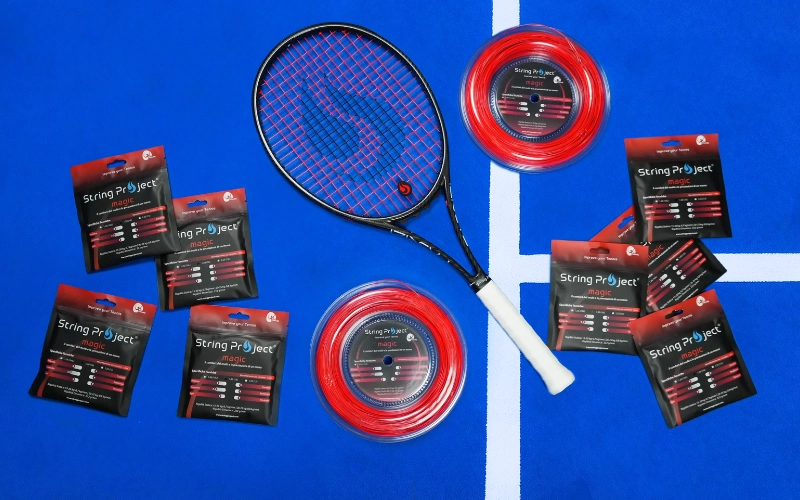
I recently tried String Project Magic Red and it really impressed me as one of the most arm-friendly poly strings I’ve used in a long time. String Project is known for making comfortable, high-performance co-polys, and Magic Red follows that philosophy by giving players a mix of power, control, and feel that makes it easy for a lot of people to use.
Where some polyester strings can feel harsh or fatiguing over long sessions, Magic Red keeps things smooth. It’s firm enough to deliver precision on full swings, yet soft enough to protect the arm — a rare balance for a performance poly.
Quick verdict
String Project Magic Red is a comfortable, control-oriented poly that doesn’t sacrifice responsiveness. It gives you that crisp, modern polyester feel with surprising comfort and forgiveness, making it a great fit for intermediate to advanced players who value both performance and playability.
Spin is easy to access thanks to its slick, low-friction surface, while the ball pocketing and directional accuracy help you hit confidently to the lines. If you’ve ever wanted a poly that feels plush but still performs under pressure, Magic Red delivers.
👉 A reliable, arm-friendly poly that balances power, control, and consistency with ease.
What the numbers and lab tests say
Independent lab-style scoring for String Project Magic Red below.
String Project Magic Red — Indicative Performance Scores
Lab data for String Project Magic Red highlights its well-balanced performance, sitting comfortably between control and comfort. Its standout areas are resilience peak (90%), tension holding (85%), and comfort (80%), showing that it’s one of the more forgiving polys in the control-focused category. The string maintains playability over time without the harsh stiffness often found in firmer co-polys.
Power (80%) and spin (80%) results show that Magic Red offers enough pop and shape on the ball to reward full, confident swings while keeping shots inside the lines. Control (75%) and stability (70%) are solid, suggesting a consistent and predictable stringbed even under pressure, ideal for players who like to play aggressively but still value feedback and touch.
The lower elasticity rating (55%) reflects a firmer core construction, meaning Magic Red doesn’t trampoline or lose tension easily — a trade-off that gives it that crisp, connected feel at impact.
👉 In short: Magic Red performs like a modern poly built for players who want a clean, consistent response with real comfort and tension stability. It’s forgiving enough for long hitting sessions but still sharp enough to deliver the feedback and precision advanced players expect.
How it plays (feel, spin, power, control)
On court, Magic Red feels smooth, crisp, and easy to swing with. The stringbed offers a slightly softer response than many control polys, giving a connected, predictable feel through contact. You can swing out with confidence, knowing the string will rein in the power while maintaining a comfortable response.
Spin generation is solid rather than extreme — there’s enough bite to shape shots and control trajectories, especially on topspin forehands and kick serves. Power sits comfortably in the medium range, with just enough pop to keep the ball lively without losing command.
The standout feature, however, is comfort. Even after hours of hitting, the string stayed stable and arm-friendly, making it perfect for players who find traditional polyester setups too stiff.
String Project Magic Red – Pros & Cons
String Project Magic Red – Here’s a quick pros and cons snapshot:
Durability & tension maintenance
Tension holding (80%) and durability (75%) make Magic Red a reliable string for players who want consistent playability across multiple sessions. It resists notching well, and the slick surface helps preserve snapback and spin over time.
It’s not built as a “tank” like some tour-level control polys, but for a softer co-poly, its longevity is impressive. The performance drop is gradual, with no sudden dead feel — just a steady, predictable fade after extended play.
👉 Overall: strong durability and stability for a comfort-oriented poly, making it easy to trust across many hitting hours. See my guide here on choosing the right tennis string tension.
Who it suits
Best For:
- Intermediate to advanced players seeking a soft, arm-friendly co-poly
- Those who value control and feel but don’t want a harsh response
- All-court players who like to vary pace and spin
Not For:
- Big hitters who want maximum spin and a firm, dead stringbed
- Players chasing the crispest tour-level feedback
- Beginners looking for effortless power
String Project Magic Red Racquet Pairing Guide
Comparable strings
If you’re considering String Project Magic Red, here’s how it stacks up against a few popular options players often cross-shop:
- Head Lynx Touch 1.25 — Similar arm-friendly vibe with great touch. Lynx Touch offers a bit more pocketing and dwell time; Magic Red feels crisper with slightly firmer directional feedback and steady tension holding.
- Mayami Tour Hex Blue 1.23 — A soft, shaped poly that leans harder into spin bite. Magic Red is smoother on impact with a more linear, controlled response; Tour Hex gives a touch more “grab” on the ball.
- Solinco Hyper-G Soft 1.25 — Bigger, more obvious spin window with a livelier launch. Magic Red is gentler on the arm and more composed, trading a bit of raw bite for cleaner feel and consistency.
- Yonex Poly Tour Pro 1.25 — The classic smooth, comfortable control poly. Magic Red plays a shade crisper and livelier; PTP is more muted and ultra-predictable.
👉 In short: Magic Red sits in the sweet spot for players who want spin and control with genuine comfort, offering a cleaner, crisper feel than many soft polys while staying easy on the arm.
Practible recommendations
Tension: Start around 22–23kg (48–51lbs) for a great balance of control and comfort. Drop by 1–2kg if you prefer extra pocketing or want a bit more pop.
Gauge: The 1.26mm version offers ideal playability for most players. Those who frequently break strings can opt for 1.30mm for added durability.
Hybrids: Works perfectly as a main string paired with a soft multifilament cross (like Babolat Xcel or Head Velocity MLT) to further boost comfort.
Restringing: Expect to restring every 10–12 hours of play for optimal performance. Its tension stability means you’ll notice a slow, predictable fade rather than a sudden drop-off.
I hope this review helped you understand what String Project Magic Red is, who it works for, and what to expect from it over time. If you want to know if Magic Red (or another string) is right for your game or if you’re ready to book a restring, just send us a message via chat!
